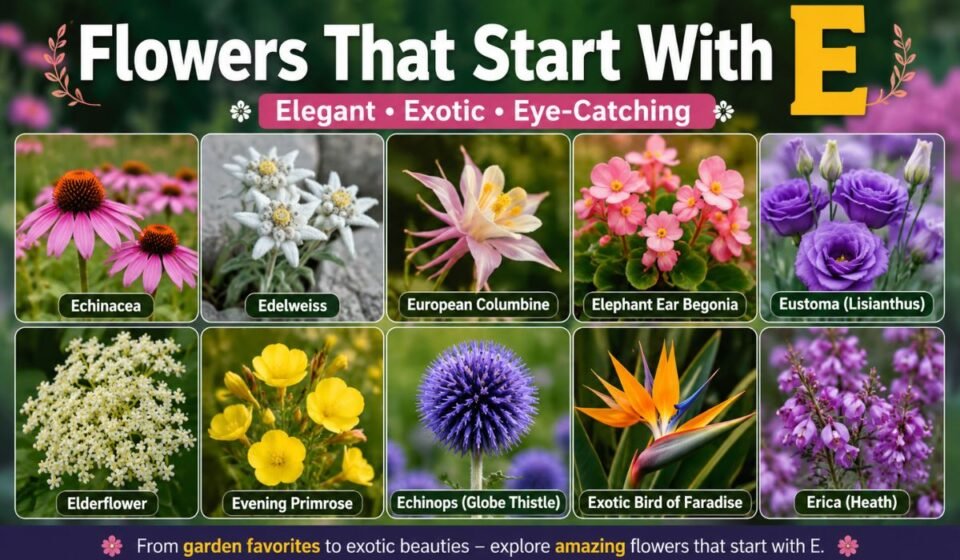
Flowers that start with the letter E bring a rare mix of elegance and variety to any garden. From the humble English Daisy to the exotic Epiphyllum, this letter covers flowers found on nearly every continent. Some are common garden favorites. Others are rare finds that only serious collectors know about.
This guide covers 90 flowers that start with E. You will find common names, scientific names, colors, and growing tips. Whether you are planning a garden, writing a school project, or just curious about flower names, this list has something useful for you.
Quick Answer: What Are Some Flowers That Start With E?
Some of the most popular flowers that start with E include Easter Lily, Echinacea, English Daisy, Evening Primrose, English Lavender, and English Bluebell. These flowers are easy to grow, widely available, and loved for their color and fragrance.
Other well known E flowers include Edelweiss, Eryngium, Eustoma, and Euphorbia. Each one has a distinct look and use, from cut flower arrangements to rock gardens.
Best Picks At A Glance
Here is a fast overview before we dive into the full list.
| Category | Flower Name |
| Easiest to grow | English Daisy |
| Most fragrant | Evening Primrose |
| Best for cutting | Eustoma (Lisianthus) |
| Best rare pick | Edelweiss |
| Best indoor flower | Exacum (Persian Violet) |
| Best pollinator flower | Echinacea |
These six flowers give a solid starting point for beginners and experienced gardeners alike.
Complete List of table 90 Flowers That Start With E
Below is the full list of 90 flowers that start with E, along with their scientific names.
| No. | Common Name | Scientific Name |
| 1 | Easter Lily | Lilium longiflorum |
| 2 | Echinacea | Echinacea purpurea |
| 3 | English Daisy | Bellis perennis |
| 4 | Evening Primrose | Oenothera biennis |
| 5 | English Lavender | Lavandula angustifolia |
| 6 | English Bluebell | Hyacinthoides non-scripta |
| 7 | Edelweiss | Leontopodium alpinum |
| 8 | Eremurus (Foxtail Lily) | Eremurus robustus |
| 9 | Erica (Winter Heath) | Erica carnea |
| 10 | Eryngium (Sea Holly) | Eryngium planum |
| 11 | Eschscholzia (California Poppy) | Eschscholzia californica |
| 12 | Euphorbia | Euphorbia marginata |
| 13 | Eustoma (Lisianthus) | Eustoma grandiflorum |
| 14 | Epidendrum Orchid | Epidendrum radicans |
| 15 | Eucomis (Pineapple Lily) | Eucomis comosa |
| 16 | Echium | Echium vulgare |
| 17 | Elderflower | Sambucus nigra |
| 18 | English Rose | Rosa English Rose group |
| 19 | English Marigold | Calendula officinalis |
| 20 | Epiphyllum (Orchid Cactus) | Epiphyllum oxypetalum |
| 21 | Erythronium (Trout Lily) | Erythronium americanum |
| 22 | Eucharis (Amazon Lily) | Eucharis amazonica |
| 23 | Euryops | Euryops pectinatus |
| 24 | Exacum (Persian Violet) | Exacum affine |
| 25 | Echeveria Flower | Echeveria elegans |
| 26 | Erigeron (Fleabane) | Erigeron karvinskianus |
| 27 | Eranthis (Winter Aconite) | Eranthis hyemalis |
| 28 | Epilobium (Fireweed) | Epilobium angustifolium |
| 29 | Erysimum (Wallflower) | Erysimum cheiri |
| 30 | Echinops (Globe Thistle) | Echinops ritro |
| 31 | Egyptian Star Cluster | Pentas lanceolata |
| 32 | Etlingera (Torch Ginger) | Etlingera elatior |
| 33 | Eucalyptus Flower | Eucalyptus globulus |
| 34 | Exochorda (Pearl Bush) | Exochorda racemosa |
| 35 | Eichhornia (Water Hyacinth) | Eichhornia crassipes |
| 36 | English Primrose | Primula vulgaris |
| 37 | English Cowslip | Primula veris |
| 38 | Empress Tree Flower | Paulownia tomentosa |
| 39 | Everlasting Flower | Helichrysum bracteatum |
| 40 | Elephant Ear Flower | Alocasia macrorrhiza |
| 41 | Evening Star Flower | Cooperia drummondii |
| 42 | Elk Thistle | Cirsium scariosum |
| 43 | Emu Bush | Eremophila maculata |
| 44 | Ewartia | Ewartia planchonii |
| 45 | Egyptian Lotus | Nymphaea lotus |
| 46 | Elephant Bush Flower | Portulacaria afra |
| 47 | English Hawthorn Flower | Crataegus laevigata |
| 48 | English Iris | Iris latifolia |
| 49 | English Ivy Flower | Hedera helix |
| 50 | Erica Gracilis | Erica gracilis |
| 51 | Erica Arborea | Erica arborea |
| 52 | Erythrina (Coral Tree Flower) | Erythrina crista-galli |
| 53 | Eucrosia | Eucrosia bicolor |
| 54 | Euonymus Flower | Euonymus europaeus |
| 55 | Eupatorium (Joe Pye Weed) | Eupatorium purpureum |
| 56 | Euphorbia Pulcherrima (Poinsettia) | Euphorbia pulcherrima |
| 57 | Euphorbia Milii (Crown of Thorns) | Euphorbia milii |
| 58 | Eutrochium | Eutrochium maculatum |
| 59 | Ensete Flower | Ensete ventricosum |
| 60 | Erica Cinerea | Erica cinerea |
| 61 | Eucomis Autumnalis | Eucomis autumnalis |
| 62 | Eucharis Grandiflora | Eucharis grandiflora |
| 63 | Eremurus Himalaicus | Eremurus himalaicus |
| 64 | Eremophila Glabra | Eremophila glabra |
| 65 | Erinus Alpinus | Erinus alpinus |
| 66 | Eritrichium (Alpine Forget Me Not) | Eritrichium nanum |
| 67 | Erodium (Storksbill) | Erodium cicutarium |
| 68 | Erysimum Linifolium | Erysimum linifolium |
| 69 | Escallonia | Escallonia rubra |
| 70 | Euryale (Gorgon Flower) | Euryale ferox |
| 71 | Eutaxia | Eutaxia obovata |
| 72 | Everlasting Daisy | Xerochrysum bracteatum |
| 73 | Evolvulus (Blue Daze) | Evolvulus glomeratus |
| 74 | Exbucklandia | Exbucklandia populnea |
| 75 | Epimedium (Barrenwort) | Epimedium grandiflorum |
| 76 | Eucnide | Eucnide urens |
| 77 | Echinocereus (Hedgehog Cactus Flower) | Echinocereus triglochidiatus |
| 78 | Elsholtzia | Elsholtzia ciliata |
| 79 | Emilia (Tassel Flower) | Emilia coccinea |
| 80 | Enkianthus | Enkianthus campanulatus |
| 81 | Epacris | Epacris impressa |
| 82 | Eranthemum | Eranthemum pulchellum |
| 83 | Erica Vagans | Erica vagans |
| 84 | Eryngium Giganteum | Eryngium giganteum |
| 85 | Eucryphia | Eucryphia glutinosa |
| 86 | Eugenia Flower | Eugenia myrtifolia |
| 87 | Euryale Ferox Flower | Euryale ferox |
| 88 | Exacum Affine (Second Type) | Exacum affine hybrid |
| 89 | Echinacea Purpurea White | Echinacea purpurea alba |
| 90 | Erica Multiflora | Erica multiflora |
How This List Was Curated?
This list was built by combining common garden flowers with lesser known species from botanical references. The goal was to balance familiar names with rare picks.
Flowers were chosen based on three factors: how widely they are grown, how easy it is to find their scientific name, and how visually distinct they are. This makes the list useful for gardeners, students, and flower lovers who want variety.
Quick Comparison
Here is a simple comparison of a few top E flowers based on care level and use.
| Flower | Sunlight Needs | Bloom Season | Best Use |
| Easter Lily | Full sun | Spring | Cut flowers |
| Echinacea | Full sun | Summer | Pollinator garden |
| English Lavender | Full sun | Summer | Fragrance and borders |
| Evening Primrose | Full sun to part shade | Summer to fall | Wildflower beds |
| Edelweiss | Full sun | Summer | Rock gardens |
| Exacum | Bright indirect light | Year round indoors | Houseplant |
This table gives a quick way to match a flower to your garden conditions without reading every profile.
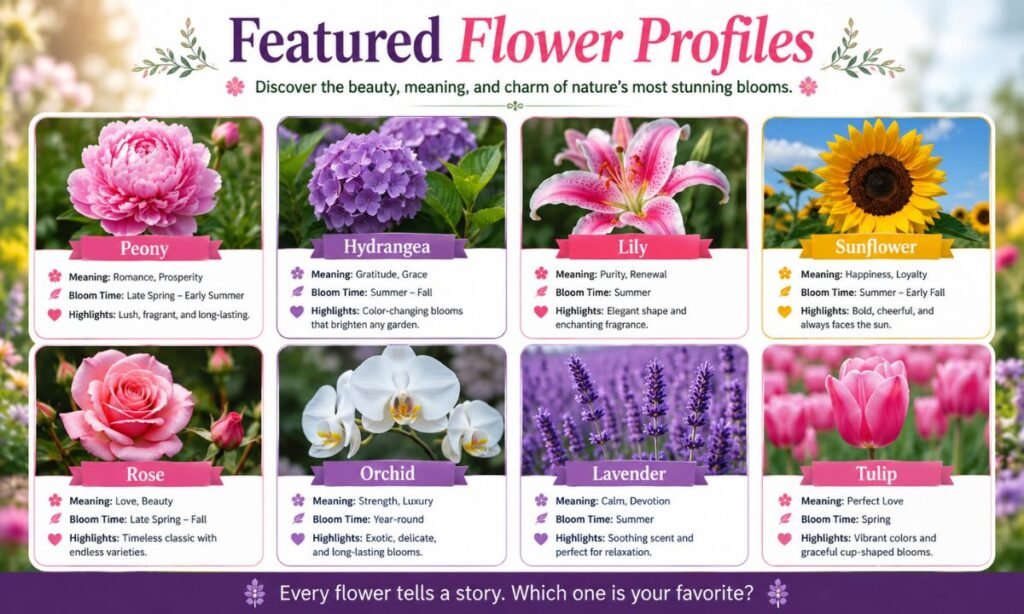
Featured Flower Profiles
Some E flowers deserve extra attention because of their popularity or unique traits.
Easter Lily is a classic symbol of spring, known for its large white trumpet shaped blooms and strong sweet scent. It is often used in religious ceremonies and spring bouquets.
Echinacea, also called Coneflower, is a tough perennial loved by bees and butterflies. It also has a long history of use in herbal remedies for immune support.
Edelweiss is a rare alpine flower found in mountain regions of Europe. Its star shaped white petals and fuzzy texture make it instantly recognizable.
Flower Meanings And Symbolism
Flowers often carry deeper meanings tied to culture and tradition. E flowers are no exception.
- Easter Lily symbolizes purity, hope, and new beginnings.
- Echinacea represents strength and healing.
- Evening Primrose stands for youth and quiet love, since it blooms at dusk.
- English Bluebell symbolizes gratitude and humility.
- Edelweiss represents courage and devotion, often linked to mountaineering stories.
These meanings make E flowers popular choices for gifts, weddings, and memorial gardens.
Common Flowers That Start With E
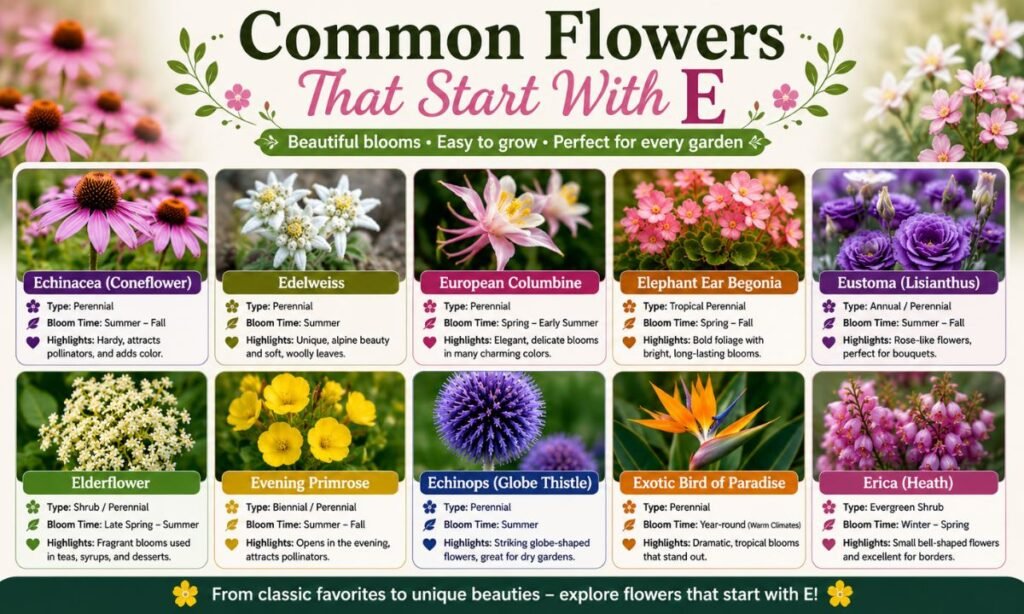
These six flowers are the most commonly grown and recognized among all E named blooms.
Easter Lily
Easter Lily is a tall bulb flower with trumpet shaped white blooms. It blooms in spring and is widely used for holidays and formal events. It prefers full sun and well drained soil.
Echinacea
Echinacea is a daisy like perennial with pink or purple petals surrounding a spiky orange center. It attracts bees, butterflies, and birds. It grows well in poor soil and needs little care.
English Daisy
English Daisy is a small low growing flower with white or pink petals and a yellow center. It is often used as ground cover or border plant. It blooms from early spring through fall.
Evening Primrose
Evening Primrose opens its yellow petals at dusk and releases a light lemon scent. It is a favorite for moth pollinators and grows well in dry, sunny spots.
English Lavender
English Lavender is prized for its purple spikes and calming fragrance. It is used in essential oils, sachets, and culinary dishes. It thrives in full sun with sandy, well drained soil.
English Bluebell
English Bluebell produces nodding, bell shaped blue flowers in woodland settings. It blooms in spring and spreads naturally in shaded, moist areas.
Common Names And Scientific Names
Many E flowers have both a common name people use casually and a scientific name used by botanists. Knowing both helps when shopping at nurseries or researching plant care.
| Common Name | Scientific Name |
| Easter Lily | Lilium longiflorum |
| Echinacea | Echinacea purpurea |
| Evening Primrose | Oenothera biennis |
| English Lavender | Lavandula angustifolia |
| Edelweiss | Leontopodium alpinum |
| English Bluebell | Hyacinthoides non-scripta |
Quick Identification Guide
Use these simple traits to identify common E flowers at a glance.
- White trumpet shape: likely an Easter Lily
- Spiky orange center with pink petals: likely Echinacea
- Purple flower spikes with strong scent: likely English Lavender
- Yellow flower that opens at night: likely Evening Primrose
- Small blue bell shaped flower in shade: likely English Bluebell
This guide is useful for beginners who are not yet familiar with scientific names.
Expanded List Of Flowers Starting With E
Beyond the common picks, there are dozens of lesser known E flowers worth exploring. These include Eremurus, Eryngium, Erysimum, Euphorbia, Eustoma, and Epidendrum orchids.
| No. | Common Name | Scientific Name |
| 1 | Easter Lily | Lilium longiflorum |
| 2 | Echinacea | Echinacea purpurea |
| 3 | English Daisy | Bellis perennis |
| 4 | Evening Primrose | Oenothera biennis |
| 5 | English Lavender | Lavandula angustifolia |
| 6 | English Bluebell | Hyacinthoides non-scripta |
| 7 | Edelweiss | Leontopodium alpinum |
| 8 | Eremurus (Foxtail Lily) | Eremurus robustus |
| 9 | Erica (Winter Heath) | Erica carnea |
| 10 | Eryngium (Sea Holly) | Eryngium planum |
| 11 | Eschscholzia (California Poppy) | Eschscholzia californica |
| 12 | Euphorbia | Euphorbia marginata |
| 13 | Eustoma (Lisianthus) | Eustoma grandiflorum |
| 14 | Epidendrum Orchid | Epidendrum radicans |
| 15 | Eucomis (Pineapple Lily) | Eucomis comosa |
| 16 | Echium | Echium vulgare |
| 17 | Elderflower | Sambucus nigra |
| 18 | English Rose | Rosa English Rose group |
| 19 | English Marigold | Calendula officinalis |
| 20 | Epiphyllum (Orchid Cactus) | Epiphyllum oxypetalum |
| 21 | Erythronium (Trout Lily) | Erythronium americanum |
| 22 | Eucharis (Amazon Lily) | Eucharis amazonica |
| 23 | Euryops | Euryops pectinatus |
| 24 | Exacum (Persian Violet) | Exacum affine |
| 25 | Echeveria Flower | Echeveria elegans |
| 26 | Erigeron (Fleabane) | Erigeron karvinskianus |
| 27 | Eranthis (Winter Aconite) | Eranthis hyemalis |
| 28 | Epilobium (Fireweed) | Epilobium angustifolium |
| 29 | Erysimum (Wallflower) | Erysimum cheiri |
| 30 | Echinops (Globe Thistle) | Echinops ritro |
| 31 | Egyptian Star Cluster | Pentas lanceolata |
| 32 | Etlingera (Torch Ginger) | Etlingera elatior |
| 33 | Eucalyptus Flower | Eucalyptus globulus |
| 34 | Exochorda (Pearl Bush) | Exochorda racemosa |
| 35 | Eichhornia (Water Hyacinth) | Eichhornia crassipes |
| 36 | English Primrose | Primula vulgaris |
| 37 | English Cowslip | Primula veris |
| 38 | Empress Tree Flower | Paulownia tomentosa |
| 39 | Everlasting Flower | Helichrysum bracteatum |
| 40 | Elephant Ear Flower | Alocasia macrorrhiza |
| 41 | Evening Star Flower | Cooperia drummondii |
| 42 | Elk Thistle | Cirsium scariosum |
| 43 | Emu Bush | Eremophila maculata |
| 44 | Ewartia | Ewartia planchonii |
| 45 | Egyptian Lotus | Nymphaea lotus |
| 46 | Elephant Bush Flower | Portulacaria afra |
| 47 | English Hawthorn Flower | Crataegus laevigata |
| 48 | English Iris | Iris latifolia |
| 49 | English Ivy Flower | Hedera helix |
| 50 | Erica Gracilis | Erica gracilis |
| 51 | Erica Arborea | Erica arborea |
| 52 | Erythrina (Coral Tree Flower) | Erythrina crista-galli |
| 53 | Eucrosia | Eucrosia bicolor |
| 54 | Euonymus Flower | Euonymus europaeus |
| 55 | Eupatorium (Joe Pye Weed) | Eupatorium purpureum |
| 56 | Euphorbia Pulcherrima (Poinsettia) | Euphorbia pulcherrima |
| 57 | Euphorbia Milii (Crown of Thorns) | Euphorbia milii |
| 58 | Eutrochium | Eutrochium maculatum |
| 59 | Ensete Flower | Ensete ventricosum |
| 60 | Erica Cinerea | Erica cinerea |
| 61 | Eucomis Autumnalis | Eucomis autumnalis |
| 62 | Eucharis Grandiflora | Eucharis grandiflora |
| 63 | Eremurus Himalaicus | Eremurus himalaicus |
| 64 | Eremophila Glabra | Eremophila glabra |
| 65 | Erinus Alpinus | Erinus alpinus |
| 66 | Eritrichium (Alpine Forget Me Not) | Eritrichium nanum |
| 67 | Erodium (Storksbill) | Erodium cicutarium |
| 68 | Erysimum Linifolium | Erysimum linifolium |
| 69 | Escallonia | Escallonia rubra |
| 70 | Euryale (Gorgon Flower) | Euryale ferox |
| 71 | Eutaxia | Eutaxia obovata |
| 72 | Everlasting Daisy | Xerochrysum bracteatum |
| 73 | Evolvulus (Blue Daze) | Evolvulus glomeratus |
| 74 | Exbucklandia | Exbucklandia populnea |
| 75 | Epimedium (Barrenwort) | Epimedium grandiflorum |
| 76 | Eucnide | Eucnide urens |
| 77 | Echinocereus (Hedgehog Cactus Flower) | Echinocereus triglochidiatus |
| 78 | Elsholtzia | Elsholtzia ciliata |
| 79 | Emilia (Tassel Flower) | Emilia coccinea |
| 80 | Enkianthus | Enkianthus campanulatus |
| 81 | Epacris | Epacris impressa |
| 82 | Eranthemum | Eranthemum pulchellum |
| 83 | Erica Vagans | Erica vagans |
| 84 | Eryngium Giganteum | Eryngium giganteum |
| 85 | Eucryphia | Eucryphia glutinosa |
| 86 | Eugenia Flower | Eugenia myrtifolia |
| 87 | Euryale Ferox Flower | Euryale ferox |
| 88 | Exacum Affine (Second Type) | Exacum affine hybrid |
| 89 | Echinacea Purpurea White | Echinacea purpurea alba |
| 90 | Erica Multiflora | Erica multiflora |
| 91 | Eucomis Bicolor | Eucomis bicolor |
| 92 | Elaeagnus Flower | Elaeagnus pungens |
| 93 | Epigaea (Trailing Arbutus) | Epigaea repens |
| 94 | Elatior Begonia | Begonia elatior |
| 95 | Echinocactus (Golden Barrel Flower) | Echinocactus grusonii |
| 96 | Eremophila Nivea | Eremophila nivea |
| 97 | Erica Ventricosa | Erica ventricosa |
| 98 | Eucomis Pole Evansii | Eucomis pole-evansii |
| 99 | Exostema | Exostema caribaeum |
| 100 | Elettaria (Cardamom Flower) | Elettaria cardamomum |
Many of these flowers are used in professional floristry because of their unusual shapes and long vase life. Eryngium, for example, has a spiky, thistle like look that adds texture to bouquets.
Gardeners looking to expand beyond the basics often turn to this expanded group for more variety in color, height, and bloom time.
Explore More Flowers Guides
74 Amazing Flowers That Start With A
120 Amazing Flowers That Start With B
Rare Flowers That Start With E
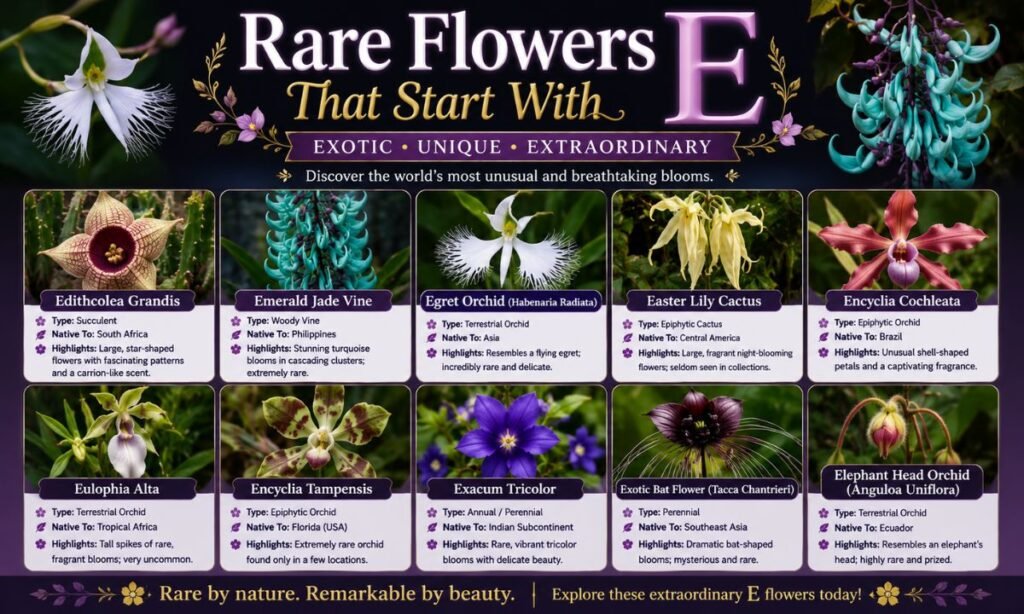
Some E flowers are hard to find outside specialty nurseries or their native regions.
- Edelweiss grows only in specific alpine climates.
- Euryale Ferox, also called the Gorgon flower, grows in ponds in Asia and has large spiny leaves.
- Eucrosia is a South American bulb flower with unusual curved petals.
- Exbucklandia is a rare flowering tree found in parts of Asia.
- Ewartia is a small alpine plant rarely grown outside Australia and New Zealand.
These rare flowers are prized by collectors and botanical gardens for their uniqueness.
Best E Flowers By Color
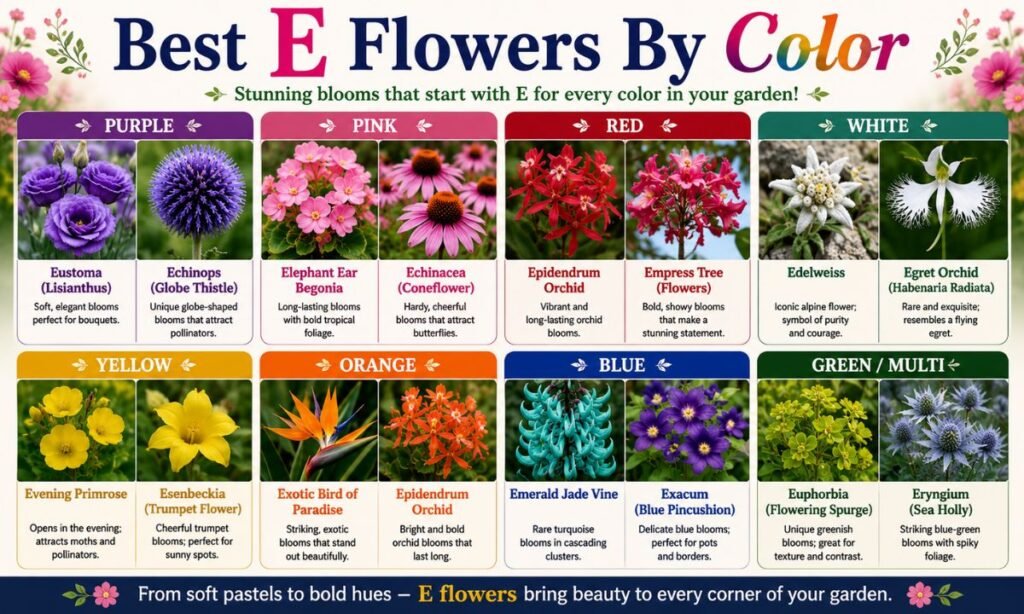
Color is often the first thing gardeners consider when picking flowers. Here is a breakdown of E flowers by shade.
Purple Flowers That Start With E
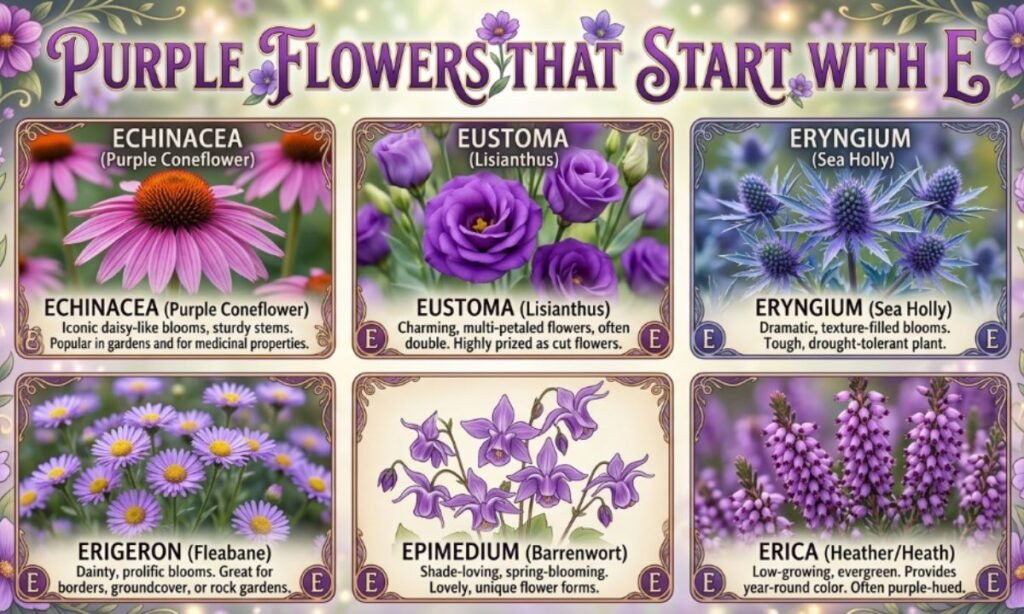
- English Lavender
- Erysimum
- Erica
- Exacum
- Eustoma
Perennial Flowers That Start With E
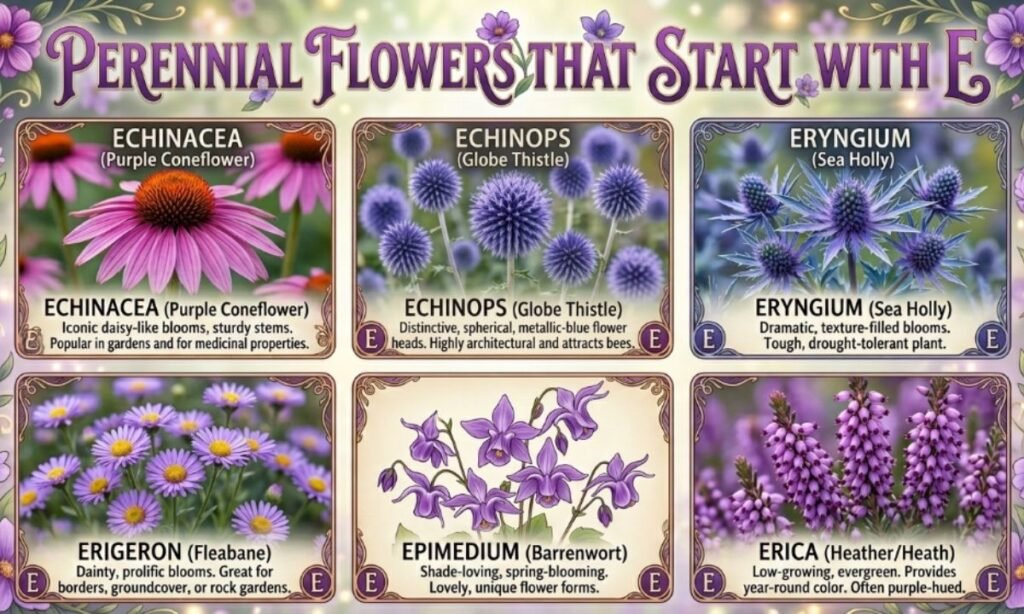
- Echinacea
- English Lavender
- Erica
- Eryngium
- Epimedium
Annual Flowers That Start With E
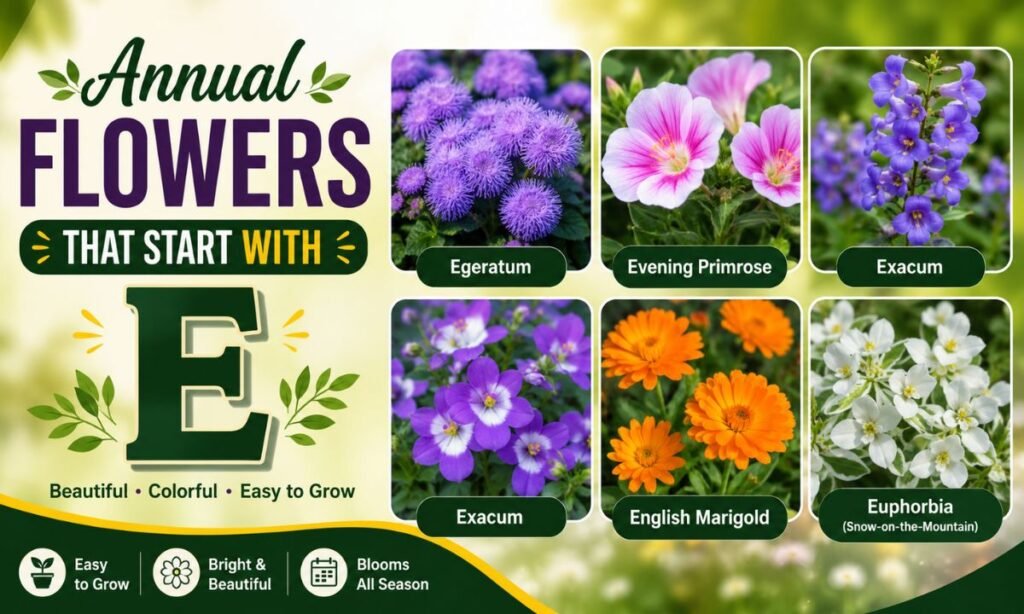
- Eschscholzia (California Poppy)
- Emilia (Tassel Flower)
- Evolvulus
- Egyptian Star Cluster
Indoor Flowers That Start With E
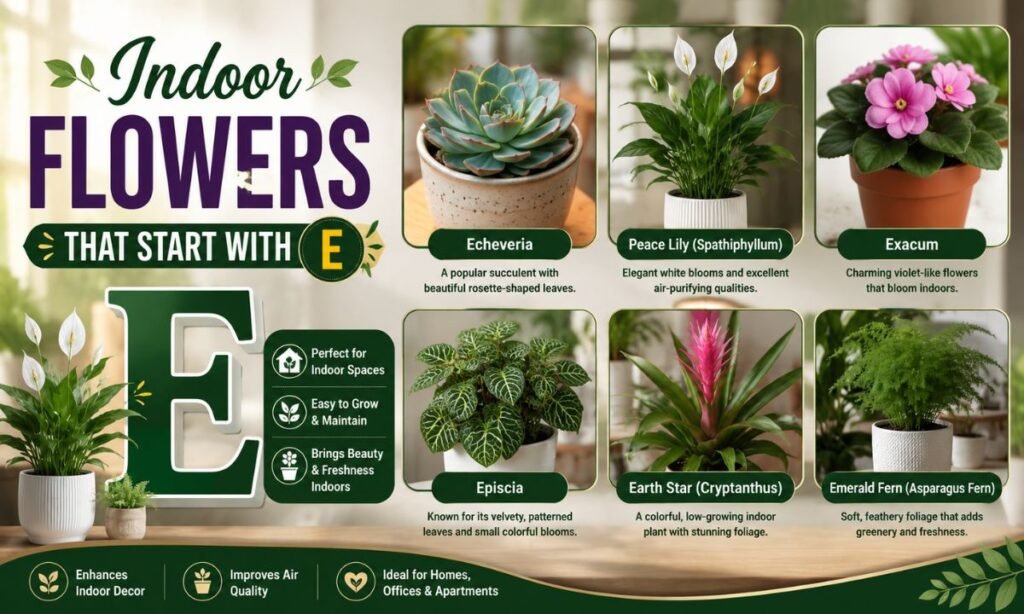
- Exacum (Persian Violet)
- Epiphyllum
- Echeveria
- Eucharis
Fragrant E Named Flowers
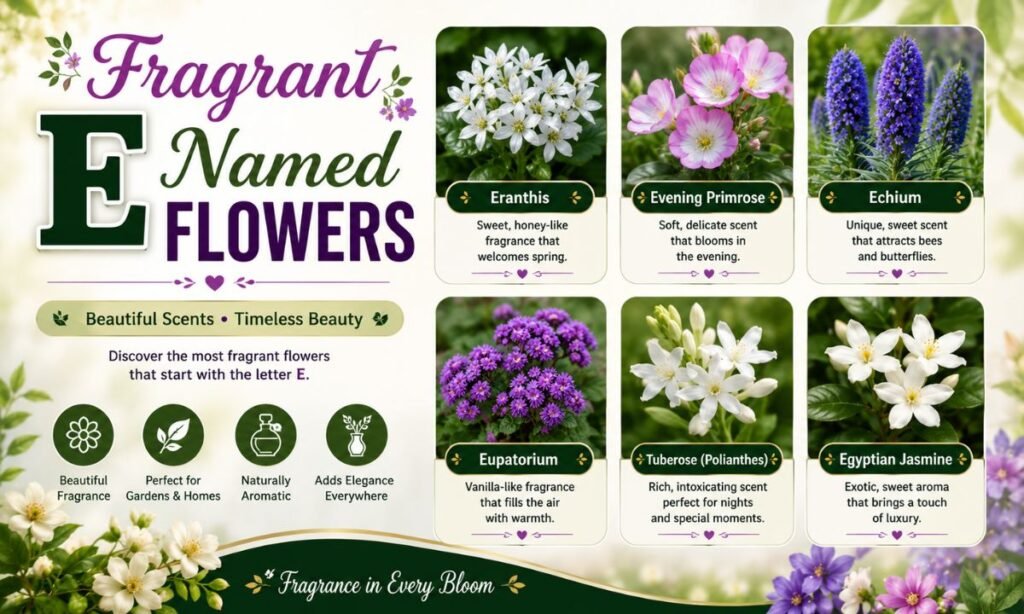
- Evening Primrose
- English Lavender
- Easter Lily
- Elderflower
Which E Flowers Are Good For Beginners?
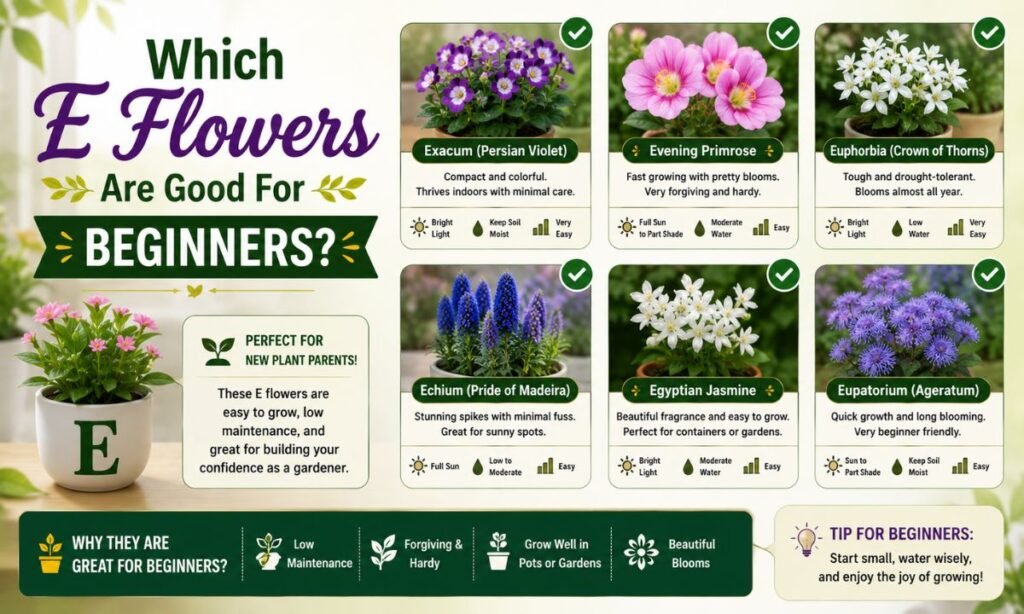
Beginners should start with English Daisy, Echinacea, and English Lavender. These flowers are forgiving, need little maintenance, and grow well in most soil types.
Avoid rare or climate specific flowers like Edelweiss until you have more gardening experience, since they require very specific conditions to thrive.
Plants Vs Flowers That Start With E
Not every plant that starts with E produces a showy flower. Some, like English Ivy, are grown mostly for foliage, while their flowers are small and easy to miss.
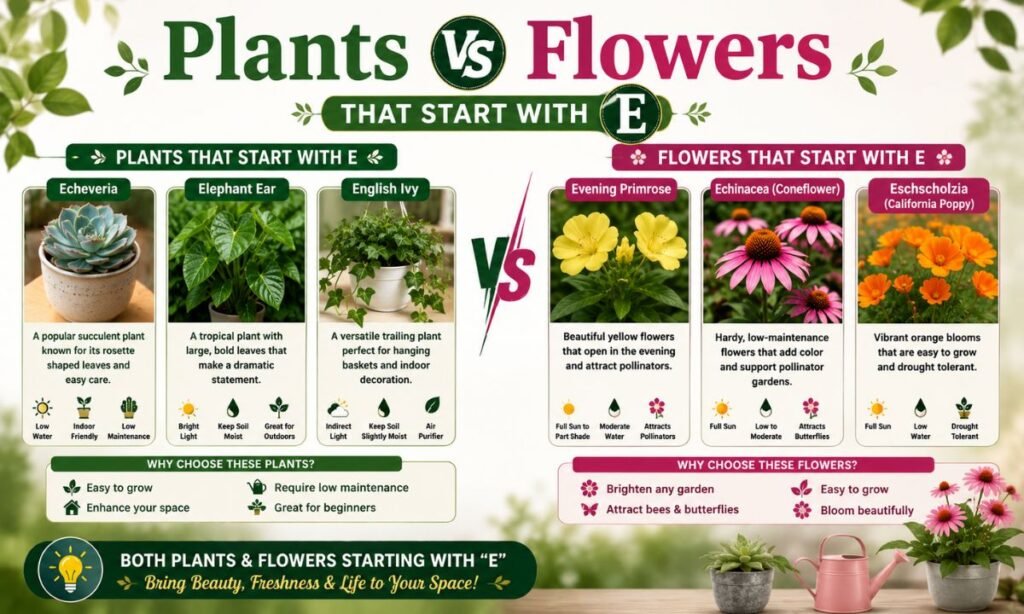
On the other hand, flowers like Echinacea and Eustoma are grown specifically for their blooms. Understanding this difference helps when planning a garden focused on color versus one focused on greenery.
| Category | Examples |
| Grown mainly for flowers | Echinacea, Eustoma, Easter Lily |
| Grown mainly for foliage | English Ivy, Euonymus |
| Grown for both | English Lavender, Erica |
Types Of Flowers That Start With E
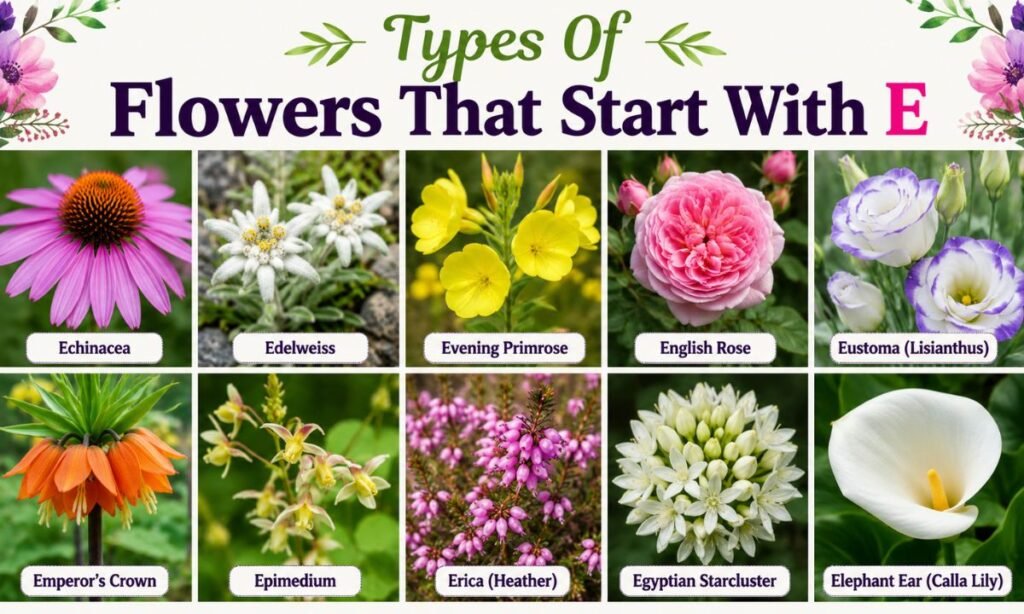
E flowers can be grouped into a few broad types based on their structure.
- Bulb flowers: Easter Lily, Eremurus, Eucomis
- Perennials: Echinacea, Erica, Eryngium
- Annuals: Eschscholzia, Emilia
- Succulent flowers: Echeveria, Euphorbia milii
- Orchids: Epidendrum, Epiphyllum
This grouping helps gardeners plan a mixed bed with different textures and bloom cycles throughout the year.
Best E Flowers By Growing Condition
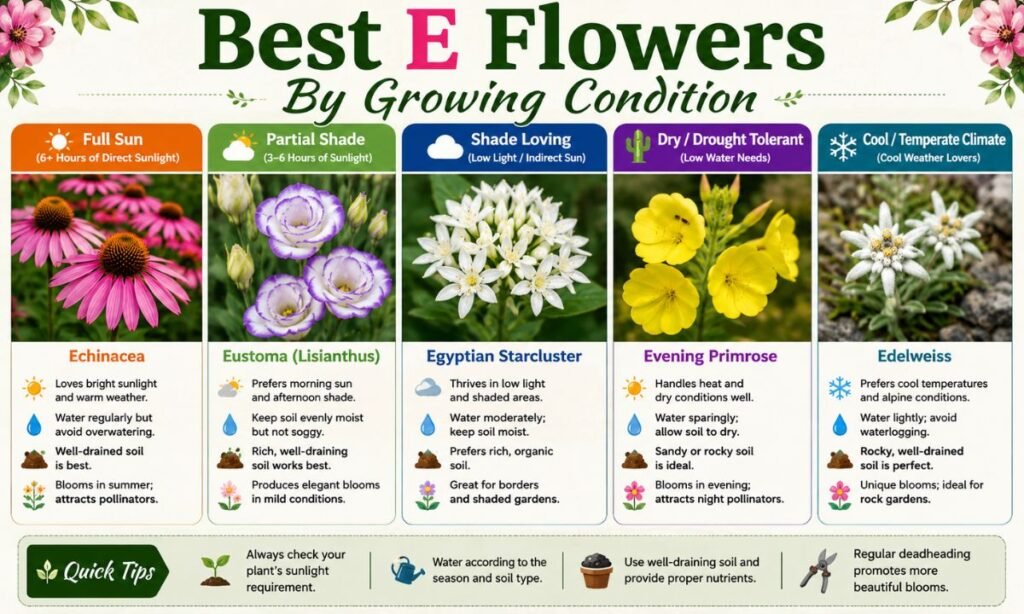
Different flowers thrive in different environments. Here is a quick guide.
| Growing Condition | Recommended E Flowers |
| Full sun, dry soil | Eschscholzia, English Lavender |
| Shade, moist soil | English Bluebell, Erythronium |
| Indoor, low light | Exacum, Epipremnum-adjacent orchids |
| Rock gardens | Edelweiss, Erinus alpinus |
| Wet or pond areas | Euryale Ferox, Eichhornia |
Matching flowers to your actual growing conditions reduces plant loss and saves time.
How To Choose The Right E Flower By Garden Use?
Choosing the right flower depends on what you want from your garden.
- For pollinators: Echinacea and Erysimum attract bees and butterflies effectively.
- For cut flowers: Eustoma and Easter Lily hold up well in vases.
- For fragrance: English Lavender and Evening Primrose add scent to outdoor spaces.
- For low maintenance: English Daisy and Erica require minimal upkeep.
- For indoor decor: Exacum and Epiphyllum work well in pots.
Thinking about purpose first makes it easier to narrow down which E flower fits your space.
Conclusion
Flowers that start with E offer an impressive range of colors, shapes, and uses. From the well known Easter Lily to the rare Edelweiss, this letter covers flowers suited for nearly every garden style and skill level.
Whether you want a low maintenance border plant, a fragrant addition to your yard, or a rare specimen for a collection, this list of 90 flowers gives you plenty of options to explore and grow.
Frequently Asked Questions
What is the most popular flower that starts with E?
Echinacea is one of the most popular E flowers due to its easy care and pollinator appeal. Easter Lily is also widely popular, especially in spring.
Are there any purple flowers that start with E?
Yes, English Lavender, Erysimum, and Eustoma all commonly bloom in shades of purple. These are great choices for adding cool tones to a garden.
What flower starting with E is good for beginners?
English Daisy and Echinacea are ideal for beginners because they tolerate different soil types and need little maintenance.
Is Edelweiss easy to grow at home?
No, Edelweiss needs cold alpine conditions and is difficult to grow outside its native climate. It is best suited for experienced gardeners or specialty rock gardens.
What is a fragrant flower that starts with E?
Evening Primrose and English Lavender are both known for their strong, pleasant fragrance. They are popular choices for scented gardens.
Can flowers that start with E grow indoors?
Yes, Exacum and Epiphyllum are two E flowers that grow well indoors with bright, indirect light. They make attractive houseplants.
What does the Echinacea flower symbolize?
Echinacea symbolizes strength and healing. It has also been used traditionally in herbal medicine for immune support.