
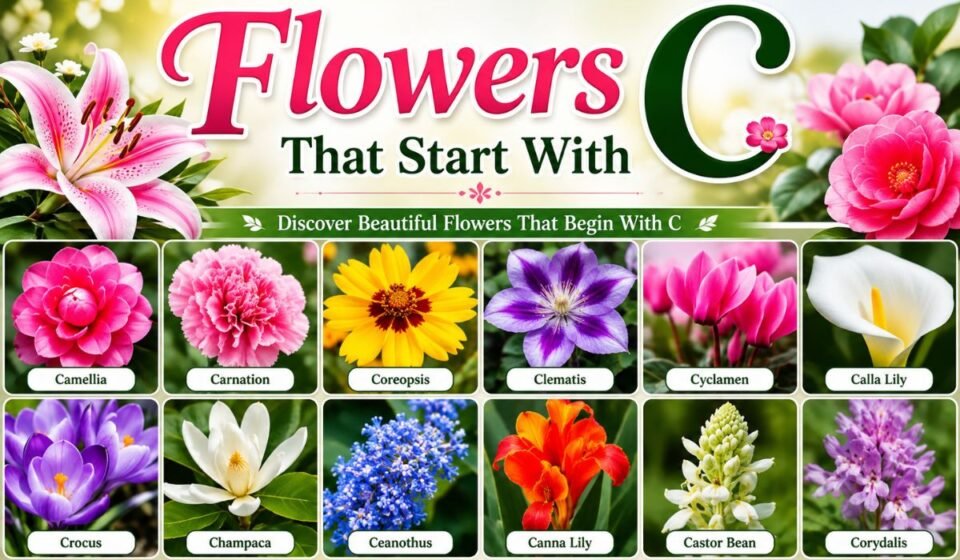
Flowers that start with C are some of the most loved blooms in gardens worldwide. From the classic Carnation to the exotic Cattleya Orchid, this letter offers a huge variety. Gardeners, florists, and flower lovers all find something special in this group.
This guide covers common types, rare finds, colors, seasons, meanings, and safety tips. You will also get quick tables for fast reference. Whether you are planting a garden or picking a bouquet, this list has you covered.
Quick Answer: What Are The Most Popular C Flowers?
The most popular C flowers include Carnation, Camellia, Chrysanthemum, Cosmos, Clematis, Crocus, and Calla Lily. These flowers are widely grown because they are easy to care for and look stunning in gardens or vases.
Carnations are a top choice for bouquets due to their long vase life. Camellias are prized for their glossy leaves and elegant blooms. Cosmos and Crocus add color to gardens in different seasons, making them favorites for beginner and expert gardeners alike.
How This 85 Flower List Was Curated?
This list was built by researching botanical databases, gardening guides, and horticultural societies. Each flower was checked for its common name starting with C, growth habits, and popularity among gardeners.
We focused on a mix of common garden flowers and rare species. The goal was to give you a well rounded list covering colors, seasons, and uses. Every entry included here has verified naming and growing information.
Plants Vs Flowers That Start With C
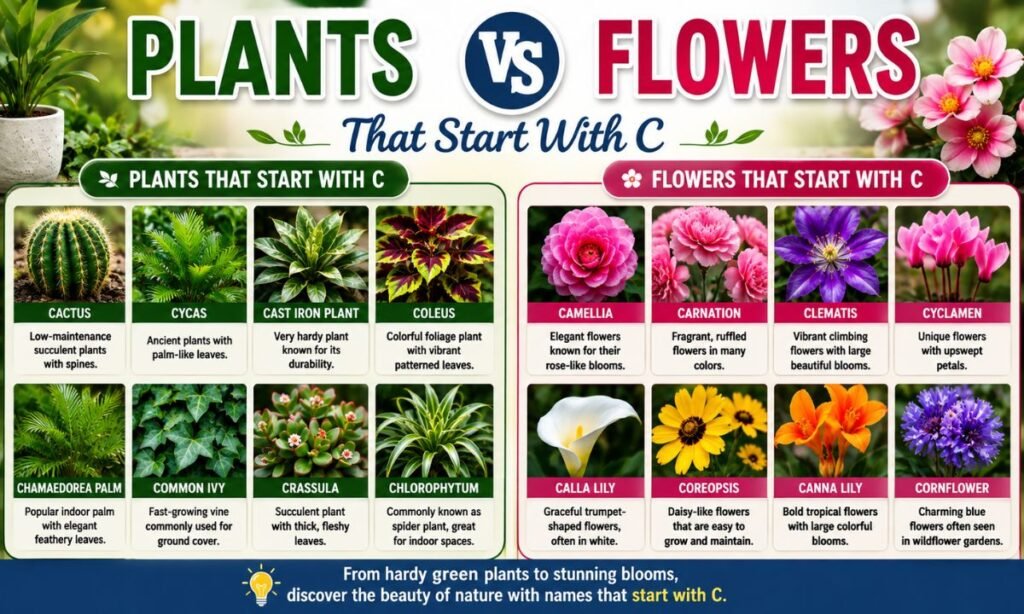
Not every plant that starts with C produces a showy flower. Some are grown mainly for foliage, fruit, or fragrance, while their blooms are small or unnoticed. Understanding this difference helps gardeners choose the right plant for their goals.
Flowering plants like Camellia and Clematis are grown specifically for their blossoms. Other C plants, such as Cactus varieties, may be grown for shape and texture, with flowers as a seasonal bonus.
| # | Plant Name | Flower or Plant? | Scientific Name |
| 1 | Cactus | Plant | Cactaceae |
| 2 | Canna Lily | Flower | Canna indica |
| 3 | Camellia | Flower | Camellia japonica |
| 4 | Calendula | Flower | Calendula officinalis |
| 5 | Carnation | Flower | Dianthus caryophyllus |
| 6 | Chrysanthemum | Flower | Chrysanthemum × morifolium |
| 7 | Columbine | Flower | Aquilegia spp. |
| 8 | Coneflower | Flower | Echinacea purpurea |
| 9 | Coreopsis | Flower | Coreopsis spp. |
| 10 | Cosmos | Flower | Cosmos bipinnatus |
| 11 | Crocus | Flower | Crocus spp. |
| 12 | Cyclamen | Flower | Cyclamen persicum |
| 13 | Crown Imperial | Flower | Fritillaria imperialis |
| 14 | Candytuft | Flower | Iberis sempervirens |
| 15 | Cleome | Flower | Cleome hassleriana |
| 16 | Chinese Lantern | Flower | Physalis alkekengi |
| 17 | Coral Bells | Flower | Heuchera spp. |
| 18 | Chocolate Cosmos | Flower | Cosmos atrosanguineus |
| 19 | Cornflower | Flower | Centaurea cyanus |
| 20 | Cockscomb | Flower | Celosia argentea |
| 21 | Calla Lily | Flower | Zantedeschia aethiopica |
| 22 | Catmint | Flower | Nepeta spp. |
| 23 | Creeping Phlox | Flower | Phlox subulata |
| 24 | Chinese Forget-Me-Not | Flower | Cynoglossum amabile |
| 25 | California Poppy | Flower | Eschscholzia californica |
| 26 | Cape Primrose | Flower | Streptocarpus spp. |
| 27 | Clivia | Flower | Clivia miniata |
| 28 | Cuphea | Flower | Cuphea hyssopifolia |
| 29 | Crape Myrtle | Flower | Lagerstroemia indica |
| 30 | Coral Vine | Flower | Antigonon leptopus |
| 31 | Crossvine | Flower | Bignonia capreolata |
| 32 | Christmas Cactus | Plant | Schlumbergera spp. |
| 33 | Chinese Evergreen | Plant | Aglaonema spp. |
| 34 | Croton | Plant | Codiaeum variegatum |
| 35 | Coleus | Plant | Coleus scutellarioides |
| 36 | Cycad | Plant | Cycas revoluta |
| 37 | Cedar | Plant | Cedrus spp. |
| 38 | Cypress | Plant | Cupressus spp. |
| 39 | Cedar of Lebanon | Plant | Cedrus libani |
| 40 | Chinese Elm | Plant | Ulmus parvifolia |
| 41 | Crabapple | Plant | Malus spp. |
| 42 | Citrus | Plant | Citrus spp. |
| 43 | Coconut Palm | Plant | Cocos nucifera |
| 44 | Coffee Plant | Plant | Coffea arabica |
| 45 | Curry Leaf Plant | Plant | Murraya koenigii |
| 46 | Cinnamon Tree | Plant | Cinnamomum verum |
| 47 | Cashew Tree | Plant | Anacardium occidentale |
| 48 | Carob Tree | Plant | Ceratonia siliqua |
| 49 | Cotton Plant | Plant | Gossypium hirsutum |
| 50 | Corn Plant | Plant | Dracaena fragrans |
| 51 | Castor Bean | Plant | Ricinus communis |
| 52 | Chia | Plant | Salvia hispanica |
| 53 | Chickpea | Plant | Cicer arietinum |
| 54 | Clover | Plant | Trifolium spp. |
| 55 | Chicory | Plant | Cichorium intybus |
| 56 | Cilantro | Plant | Coriandrum sativum |
| 57 | Coriander | Plant | Coriandrum sativum |
| 58 | Caper Bush | Plant | Capparis spinosa |
| 59 | Cardoon | Plant | Cynara cardunculus |
| 60 | Celery | Plant | Apium graveolens |
| 61 | Cabbage | Plant | Brassica oleracea |
| 62 | Cauliflower | Plant | Brassica oleracea var. botrytis |
| 63 | Cucumber | Plant | Cucumis sativus |
| 64 | Cassava | Plant | Manihot esculenta |
| 65 | Cranberry | Plant | Vaccinium macrocarpon |
| 66 | Currant | Plant | Ribes spp. |
| 67 | Cherry Tree | Plant | Prunus avium |
| 68 | Cantaloupe | Plant | Cucumis melo |
| 69 | Cowpea | Plant | Vigna unguiculata |
| 70 | Canary Palm | Plant | Phoenix canariensis |
| 71 | China Doll Plant | Plant | Radermachera sinica |
| 72 | Calathea | Plant | Goeppertia spp. |
| 73 | Caladium | Plant | Caladium bicolor |
| 74 | Corkscrew Rush | Plant | Juncus effusus ‘Spiralis’ |
| 75 | Creeping Jenny | Plant | Lysimachia nummularia |
| 76 | Creeping Fig | Plant | Ficus pumila |
| 77 | Chinese Money Plant | Plant | Pilea peperomioides |
| 78 | Cast Iron Plant | Plant | Aspidistra elatior |
| 79 | Cordyline | Plant | Cordyline fruticosa |
| 80 | Club Moss | Plant | Lycopodium spp. |
| 81 | Carolina Jessamine | Flower | Gelsemium sempervirens |
| 82 | China Aster | Flower | Callistephus chinensis |
| 83 | Chinese Hibiscus | Flower | Hibiscus rosa-sinensis |
| 84 | Celandine Poppy | Flower | Stylophorum diphyllum |
| 85 | Cobra Lily | Flower | Darlingtonia californica |
| 86 | Chocolate Lily | Flower | Fritillaria biflora |
| 87 | Chilean Bellflower | Flower | Lapageria rosea |
| 88 | Chinese Peony | Flower | Paeonia lactiflora |
| 89 | Cupid’s Dart | Flower | Catananche caerulea |
| 90 | Canary Creeper | Flower | Tropaeolum peregrinum |
| 91 | Candle Larkspur | Flower | Delphinium consolida |
| 92 | Crimson Clover | Flower | Trifolium incarnatum |
| 93 | Creeping Thyme | Flower | Thymus serpyllum |
| 94 | Cushion Spurge | Flower | Euphorbia polychroma |
| 95 | Cat’s Ear | Flower | Hypochaeris radicata |
| 96 | Cliff Rose | Flower | Purshia stansburyana |
| 97 | Canary Daisy | Flower | Glebionis coronaria |
| 98 | Chinese Violet Cress | Flower | Orychophragmus violaceus |
| 99 | Cape Daisy | Flower | Osteospermum ecklonis |
| 100 | Cistus (Rock Rose) | Flower | Cistus spp. |
Types Of Flowers Starting With C
C flowers come in many types, including annuals, perennials, bulbs, shrubs, and climbers. This variety means there is a C flower for almost every garden style and climate.
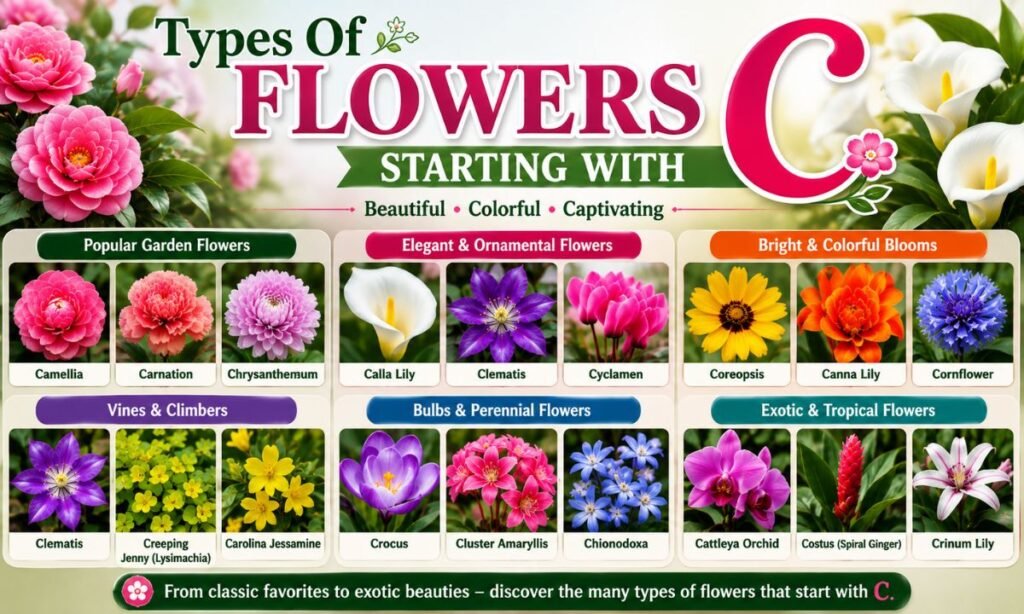
Annual types like Cosmos bloom for one season and need replanting. Perennial types like Coneflower return yearly with proper care. Bulb flowers like Crocus grow from underground storage and often signal the start of spring.
- Annuals: Cosmos, Calendula, China Aster
- Perennials: Coneflower, Columbine, Coral Bells
- Bulbs: Crocus, Canna Lily, Crown Imperial
- Climbers: Clematis, Cypress Vine, Carolina Jasmine
- Shrubs: Camellia, Confederate Rose
C Flower Names At A Glance
This table gives a fast overview of popular C flower names, their type, and bloom color for quick reference.
| Flower Name | Type | Common Color |
| Carnation | Annual/Perennial | Pink, Red, White |
| Camellia | Shrub | Pink, Red, White |
| Chrysanthemum | Perennial | Yellow, Red, Purple |
| Cosmos | Annual | Pink, White, Orange |
| Clematis | Climber | Purple, White, Pink |
| Crocus | Bulb | Purple, Yellow, White |
| Calla Lily | Bulb | White, Pink, Yellow |
| Columbine | Perennial | Blue, Red, Yellow |
| Coneflower | Perennial | Purple, White |
| Cornflower | Annual | Blue |
Common Flowers That Start With C
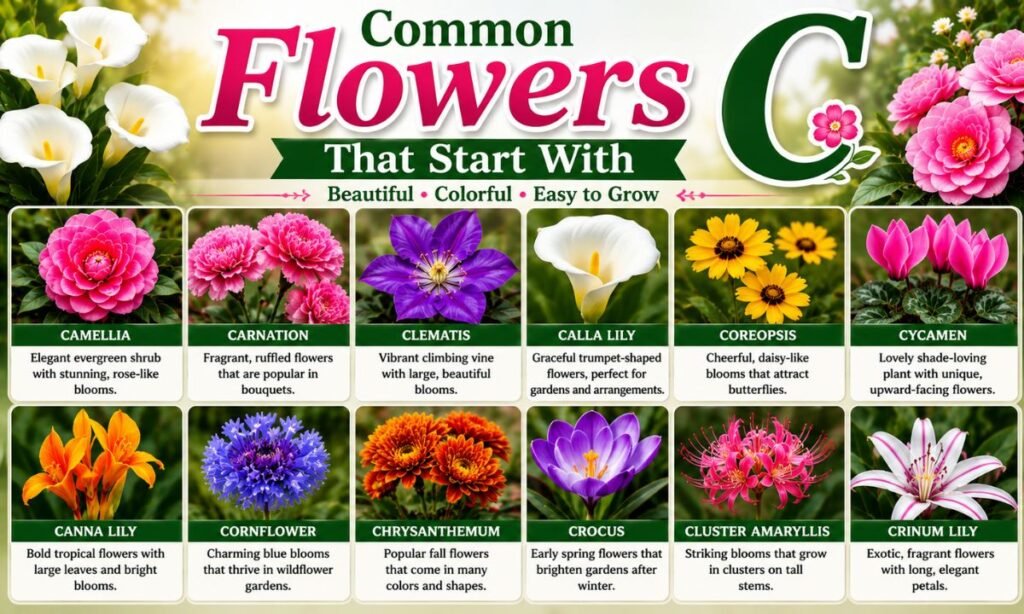
Common C flowers are easy to find at nurseries and garden centers. They are popular because they grow well in many climates and require low maintenance.
Carnations are known for their ruffled petals and spicy scent, often used in weddings. Chrysanthemums bloom in fall and come in many colors, making them a staple for autumn decor. Cosmos flowers attract butterflies and grow tall with delicate, feathery leaves.
Calla Lilies bring an elegant, trumpet shaped bloom to gardens and bouquets. Clematis vines climb fences and trellises, offering large, showy flowers all summer long.
| Flower | Bloom Season | Care Level |
| Carnation | Spring to Fall | Easy |
| Chrysanthemum | Fall | Easy |
| Cosmos | Summer to Fall | Easy |
| Calla Lily | Summer | Moderate |
| Clematis | Spring to Summer | Moderate |
Rare Flowers That Start With C
Rare C flowers are harder to find but offer unique beauty for collectors and dedicated gardeners. These blooms often need special growing conditions or are native to specific regions.
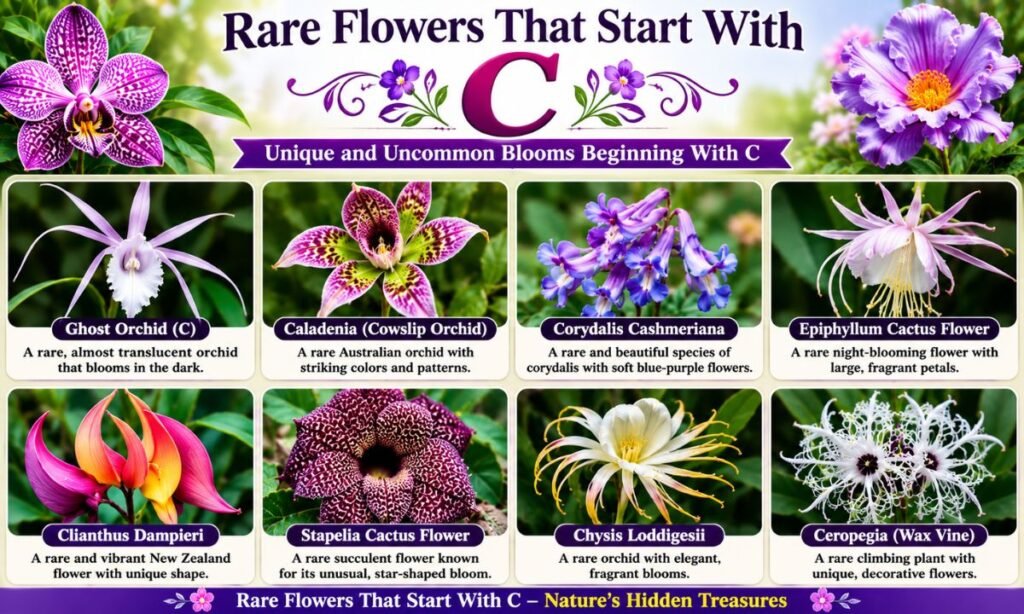
Chocolate Cosmos has a deep maroon color and a scent similar to chocolate, but it is tricky to grow outside warm climates. Chincherinchee, native to South Africa, produces star shaped white flowers on tall stems. Cattleya Orchids are prized by collectors for their large, fragrant blooms.
Corydalis offers delicate, tube shaped flowers in blue or yellow, thriving in shaded woodland gardens. Chilean Bellflower, also called Lapageria, is a climbing vine with waxy, bell shaped red blooms.
| Rare Flower | Native Region | Growing Difficulty |
| Chocolate Cosmos | Mexico | High |
| Chincherinchee | South Africa | Moderate |
| Cattleya Orchid | South America | High |
| Corydalis | Asia/Europe | Moderate |
| Chilean Bellflower | Chile | High |
Best C Flowers By Season
Different C flowers bloom at different times of year, so planning your garden around seasons helps keep color going year round.
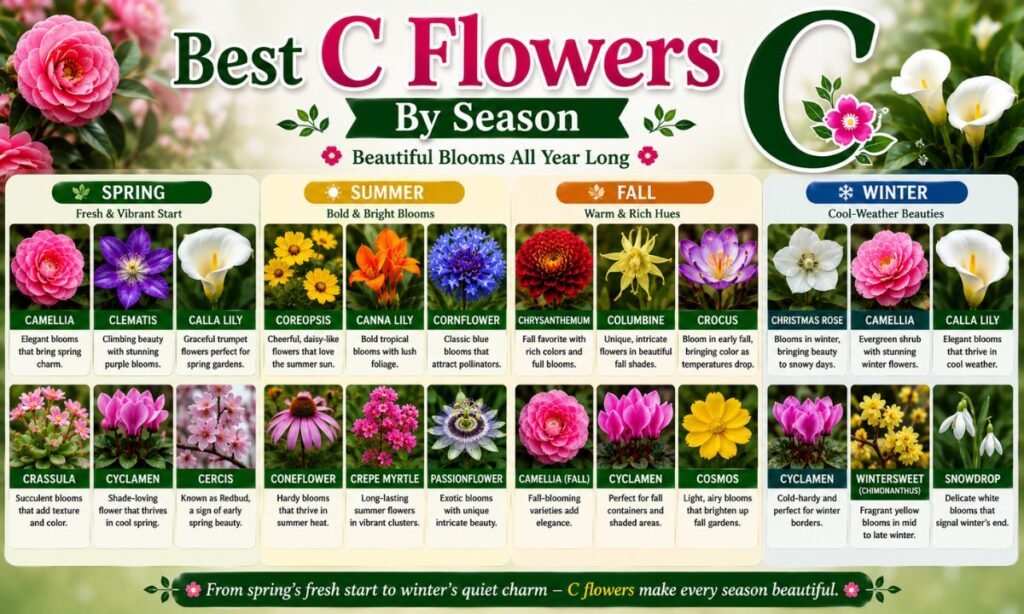
Spring brings Crocus, Columbine, and Clematis into bloom, signaling the end of winter. Summer is dominated by Cosmos, Calla Lily, and Coneflower, which thrive in warm weather. Fall belongs to Chrysanthemums, adding rich color as other flowers fade.
| Season | Top C Flowers |
| Spring | Crocus, Columbine, Clematis |
| Summer | Cosmos, Calla Lily, Coneflower |
| Fall | Chrysanthemum, Confederate Rose |
| Winter | Camellia, Christmas Rose |
C Flower Names By Color
Color is often the first thing gardeners consider when choosing flowers. C flowers offer a wide color range, from soft pastels to bold, vibrant shades.
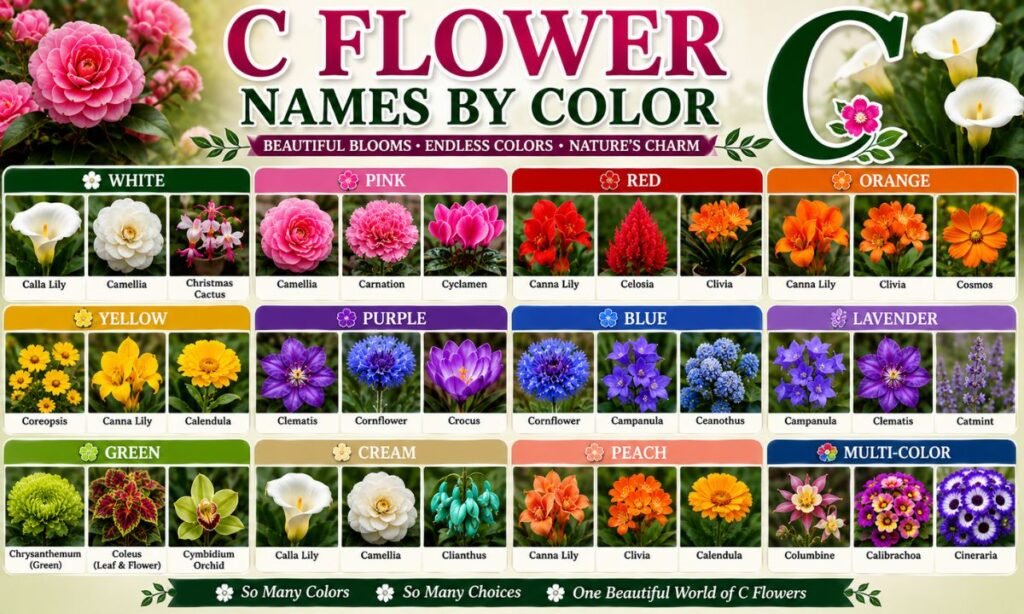
White blooms like Calla Lily and Candytuft bring a clean, elegant look to gardens. Purple flowers such as Clematis and Coneflower add rich depth to borders. Yellow blooms like Calendula and Coreopsis bring warmth and cheer.
| Color | Flower Examples |
| White | Calla Lily, Candytuft, Christmas Rose |
| Purple | Clematis, Coneflower, Crocus |
| Yellow | Calendula, Coreopsis, Crown Imperial |
| Red | Carnation, Camellia, Cardinal Flower |
| Blue | Cornflower, Columbine, Campanula |
Indoor And Container Friendly C Flowers
Some C flowers grow well indoors or in pots, making them great for small spaces, patios, and apartments. These varieties usually have compact growth and manageable root systems.
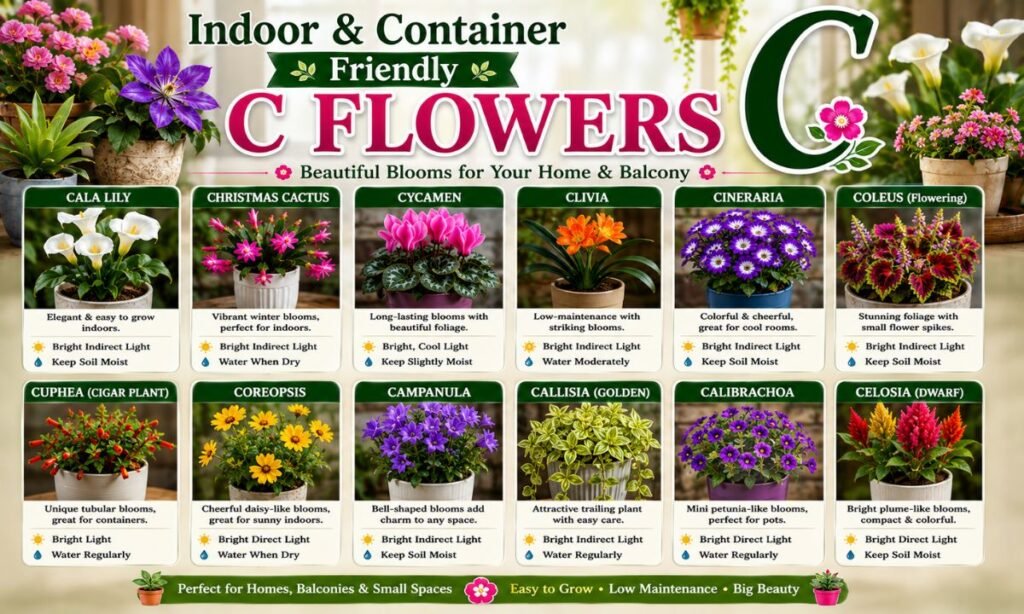
Cyclamen is a favorite for indoor pots, offering winter blooms in pink, red, and white. Calendula grows easily in containers and adds bright color to balconies. Crossandra, with its orange trumpet shaped flowers, thrives indoors in bright light.
- Cyclamen: winter blooming, cool indoor spaces
- Calendula: bright, container friendly
- Crossandra: warm climate, indoor bright light
- Cattleya Orchid: indoor greenhouse conditions
Explore More Flowers Guides
Beginner Friendly C Flowers
New gardeners often look for flowers that forgive small mistakes. C flowers offer several low maintenance options that reward beginners with reliable blooms.
Cosmos is one of the easiest flowers to grow from seed, tolerating poor soil and little water. Calendula also grows fast and self seeds, meaning it often returns without replanting. Coneflower is a hardy perennial that survives drought and attracts pollinators with minimal care.
| Flower | Why It Is Beginner Friendly |
| Cosmos | Grows fast, tolerates poor soil |
| Calendula | Self seeds, low maintenance |
| Coneflower | Drought tolerant, hardy perennial |
| China Aster | Simple care, colorful blooms |
Wildflowers And Pollinator-Friendly Picks
Many C flowers attract bees, butterflies, and other pollinators, making them great choices for wildlife gardens. These flowers often grow naturally in meadows and open fields.
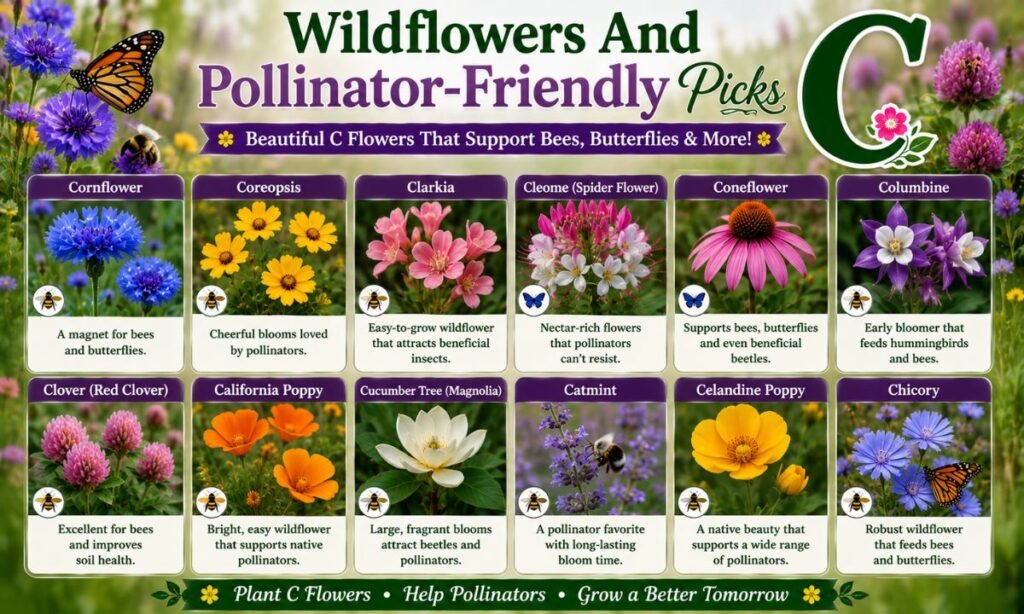
Cornflower is a classic wildflower loved by bees and often used in native seed mixes. Coneflower attracts butterflies and goldfinches, who feed on its seeds in fall. Cardinal Flower draws hummingbirds with its bright red, tubular blooms.
- Cornflower: bee friendly wildflower
- Coneflower: butterfly and bird magnet
- Cardinal Flower: hummingbird favorite
- Corn Poppy: pollinator friendly meadow flower
Best C Flowers For Garden Use
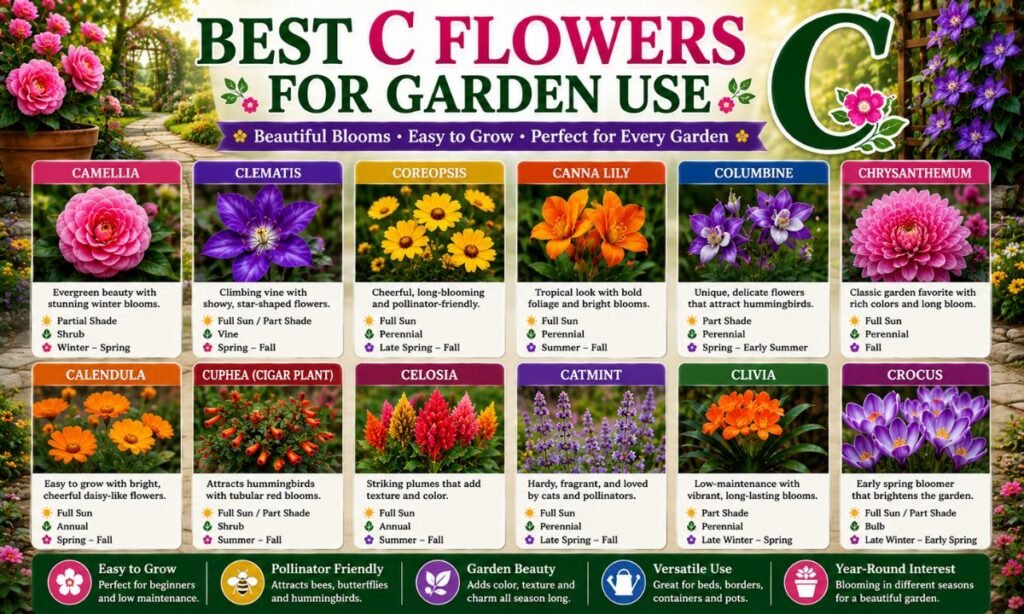
Choosing the right C flower depends on where you plan to plant it. Some thrive in borders, others in containers, and some need specific light conditions to succeed.
Borders
Border plants need to hold their shape, bloom for long stretches, and look good next to neighboring plants. C flowers used for borders usually have sturdy stems and a tidy growth habit that does not flop over.
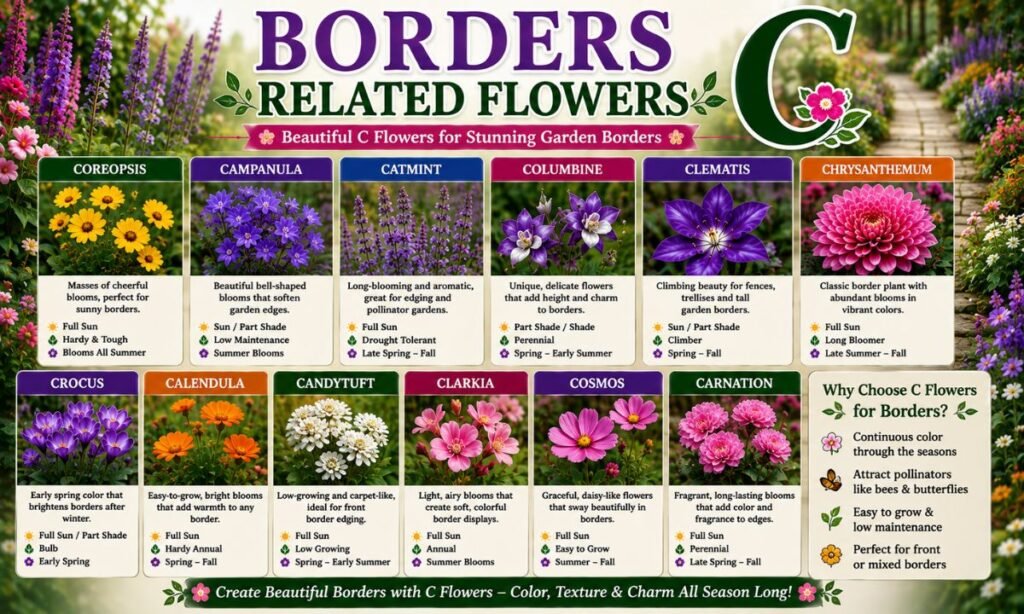
Coneflower stands tall along border edges and keeps blooming from early summer into fall. Chrysanthemum adds structure and color right when most border plants start fading. China Aster fills gaps nicely with its dense, bushy shape and steady bloom cycle.
| Flower | Height | Bloom Time | Why It Works For Borders |
|---|---|---|---|
| Coneflower | 2 to 4 ft | Summer to Fall | Sturdy stems, long bloom |
| Chrysanthemum | 1 to 3 ft | Fall | Bushy shape, late color |
| China Aster | 1 to 2 ft | Summer to Fall | Dense growth, fills gaps |
| Cornflower | 1 to 2 ft | Spring to Summer | Upright, airy texture |
Containers
Container flowers need compact roots, manageable size, and tolerance for pot conditions where soil dries faster than in the ground. C flowers grown in containers work well on patios, balconies, and porches.
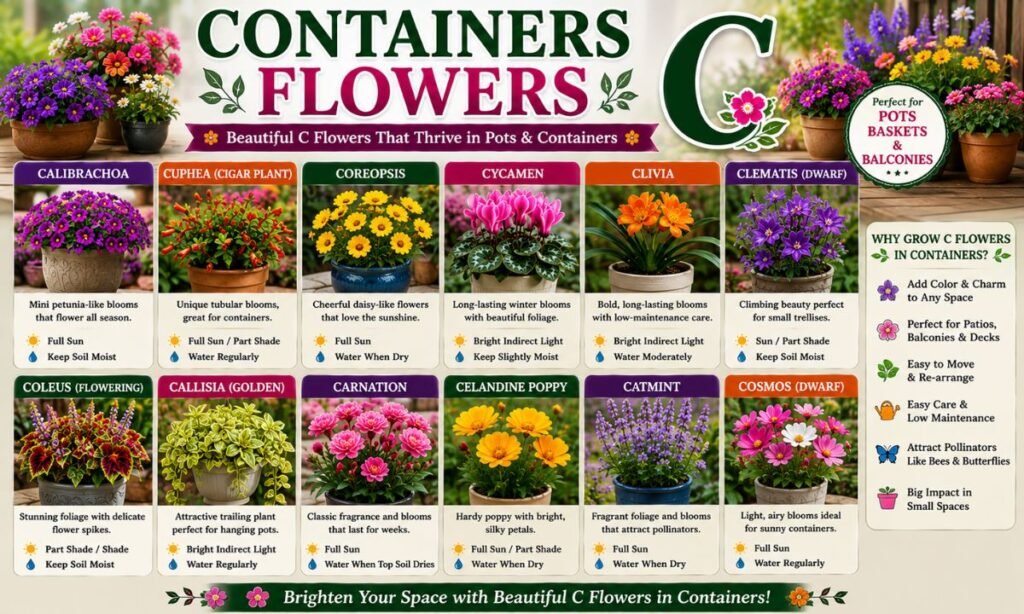
Calendula is a top pick for pots because it blooms quickly and handles some neglect. Cyclamen suits smaller containers and adds color during cooler months when many other flowers are dormant. Crossandra brings tropical color to warm patios and does well in bright containers indoors or out.
| Flower | Pot Size Needed | Light Needs | Best Season For Pots |
|---|---|---|---|
| Calendula | Small to Medium | Full Sun | Spring to Fall |
| Cyclamen | Small | Bright Indirect | Fall to Winter |
| Crossandra | Small to Medium | Bright Light | Summer |
| Cattleya Orchid | Medium | Bright Indirect | Year Round Indoors |
Trellises And Fences
Climbing C flowers need support to grow upward, making trellises and fences a natural fit. These vines fill vertical space and often bloom heavily once established.
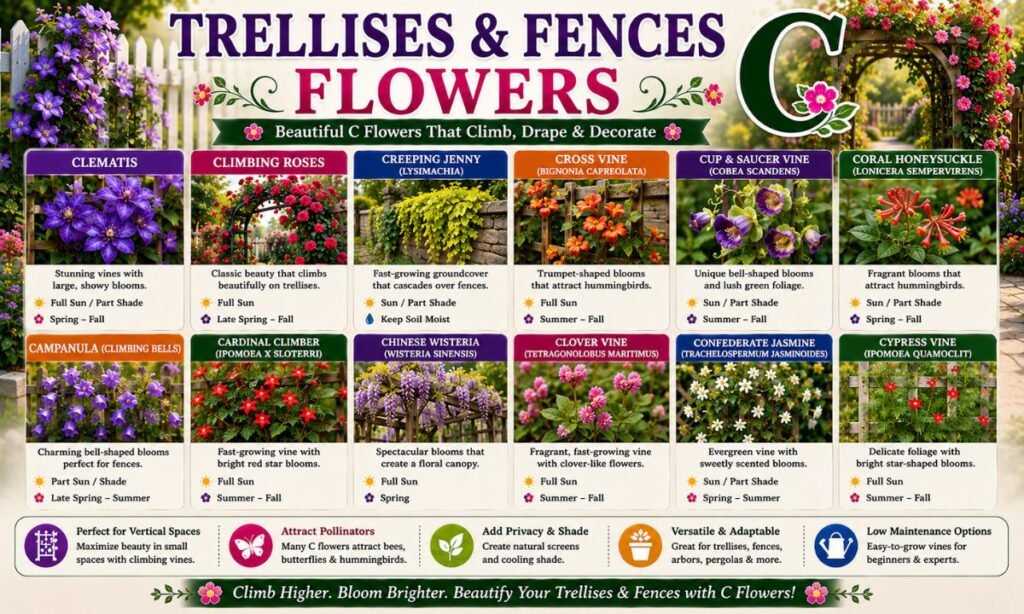
Clematis is the classic choice for trellises, offering large flowers all summer long with proper pruning. Cypress Vine grows fast and covers fences quickly, with feathery leaves and small star shaped blooms. Carolina Jasmine adds a fragrant, golden touch to fences in early spring.
| Flower | Growth Speed | Support Type | Bloom Season |
|---|---|---|---|
| Clematis | Moderate | Trellis, Fence | Spring to Summer |
| Cypress Vine | Fast | Fence, Netting | Summer to Fall |
| Carolina Jasmine | Moderate | Fence, Arbor | Early Spring |
| Chilean Bellflower | Slow | Trellis | Summer to Fall |
Shade Or Part Shade
Not every C flower needs full sun. Some varieties actually prefer filtered light and thrive under trees or on the north side of buildings where direct sun is limited.
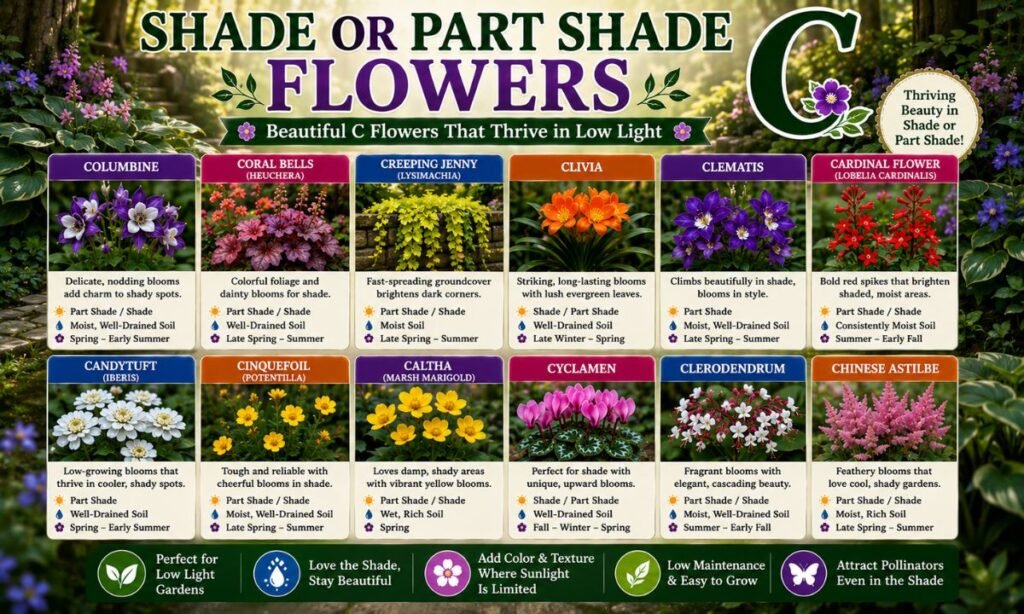
Corydalis grows well in woodland settings, producing delicate blooms even in low light. Columbine tolerates part shade and adds soft color to shaded borders. Christmas Rose, despite its name, prefers shady spots and blooms in winter when little else is flowering.
| Flower | Shade Tolerance | Bloom Color | Best Location |
|---|---|---|---|
| Corydalis | Full to Part Shade | Blue, Yellow | Woodland beds |
| Columbine | Part Shade | Blue, Red, Yellow | Shaded borders |
| Christmas Rose | Part Shade | White, Pink | Winter shade gardens |
| Candytuft | Light Shade | White | Edging under trees |
Dry Or Sunny Spots
Some C flowers are built for tough conditions, handling heat, drought, and full sun without much extra care. These are ideal for xeriscaping or low water gardens.
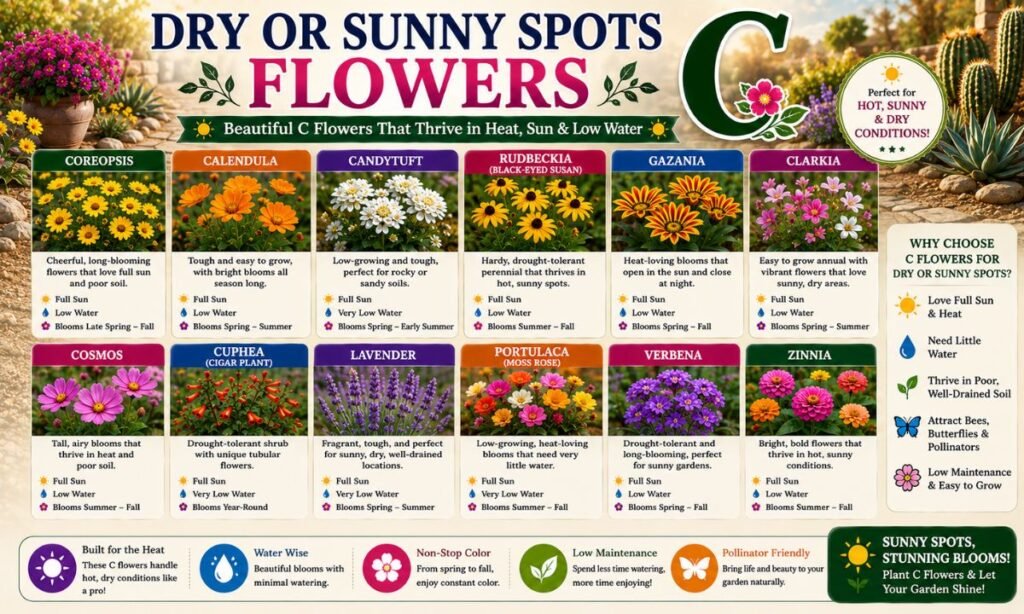
Cosmos thrives in dry, sunny beds and often blooms better with less water and lean soil. Coneflower is drought tolerant once established and handles hot afternoon sun with ease. Calendula also does well in dry conditions, needing only occasional watering to keep blooming.
| Flower | Drought Tolerance | Sun Needs | Watering Frequency |
|---|---|---|---|
| Cosmos | High | Full Sun | Low |
| Coneflower | High | Full Sun | Low |
| Calendula | Moderate | Full Sun | Moderate |
| Cornflower | High | Full Sun | Low |
C Flower Meanings And Symbolism
Flowers often carry symbolic meanings tied to emotions, occasions, or history. C flowers have a rich tradition of symbolism used in bouquets and gifts.
Carnations symbolize love and fascination, with different colors carrying different meanings, such as pink for gratitude. Chrysanthemums represent joy and long life in many cultures, especially in parts of Asia. Camellias symbolize admiration and perfection, often gifted to express deep affection.
| Flower | Symbolic Meaning |
| Carnation | Love, fascination |
| Chrysanthemum | Joy, long life |
| Camellia | Admiration, perfection |
| Columbine | Faithfulness |
| Crocus | Cheerfulness, new beginnings |
Origin And Native Range Of Popular C Flowers
Understanding where a flower originates helps explain its growing needs and cultural significance. C flowers come from regions across the globe, from Europe to South America.
Carnations trace their roots to the Mediterranean region, where they have been cultivated for centuries. Camellias originated in Eastern Asia, particularly China and Japan, where they hold cultural importance. Cosmos flowers come from Mexico, thriving in warm climates before spreading worldwide.
| Flower | Native Region |
| Carnation | Mediterranean |
| Camellia | East Asia |
| Cosmos | Mexico |
| Clematis | Asia, Europe |
| Crocus | Europe, Middle East |
Safety And Toxicity Notes For C Flowers
Not all C flowers are safe around pets and children, so it helps to know which ones require caution. Some contain compounds that can cause irritation or illness if ingested.
Calla Lily contains calcium oxalate crystals, which can irritate the mouth and throat if chewed. Clematis sap may cause skin irritation in sensitive individuals. Chrysanthemums are generally mild but can cause allergic reactions in some pets.
- Calla Lily: toxic to pets, irritant if chewed
- Clematis: sap may irritate skin
- Chrysanthemum: mild toxicity risk for pets
- Camellia: generally considered safe
Common Mistakes When Choosing C Flowers
Many gardeners run into avoidable problems when picking C flowers for their space. Knowing these mistakes ahead of time can save time and money.
A common error is planting sun loving flowers like Cosmos in shaded areas, leading to weak growth. Another mistake is overwatering Camellias, which prefer well drained soil. Choosing tender perennials like Cattleya Orchids without proper indoor care in cold climates often leads to plant loss.
| Mistake | Better Approach |
| Planting Cosmos in shade | Choose full sun spots |
| Overwatering Camellia | Use well drained soil |
| Growing Orchids outdoors in cold | Keep tender types indoors |
Quick Identification Guide For C Flowers
Identifying C flowers becomes easier when you focus on petal shape, leaf structure, and bloom pattern. This quick guide highlights key features for common types.
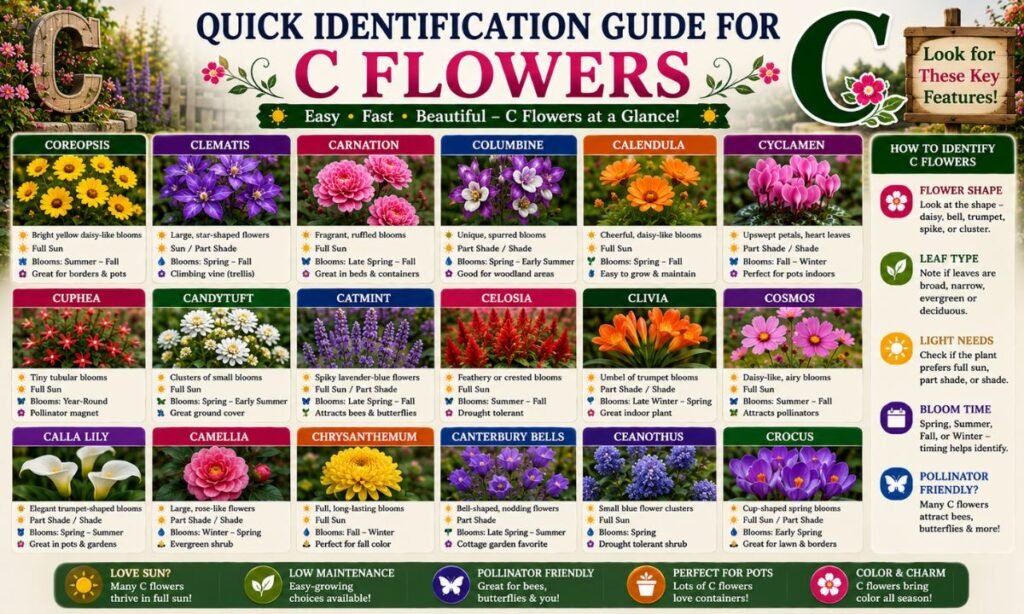
Carnations have ruffled, fringed petals and a spicy clove like scent. Clematis flowers are star shaped with pointed petals, often climbing on vines. Coneflowers have a raised, cone shaped center surrounded by drooping petals, making them easy to spot in gardens.
| Flower | Key Identifying Feature |
| Carnation | Ruffled petals, clove scent |
| Clematis | Star shaped, climbing vine |
| Coneflower | Raised cone center |
| Calla Lily | Trumpet shaped, single petal |
Fragrant C Flowers And Bouquet Favorites
Some C flowers are chosen specifically for their scent, making them popular in bouquets, perfumes, and garden borders near seating areas.
Carnations are known for their strong, spicy fragrance, often used in weddings and celebrations. Camellias offer a light, sweet scent alongside their glossy blooms. Clematis varieties, especially sweet autumn clematis, produce a vanilla like fragrance that fills the garden in late summer.
- Carnation: spicy, clove like scent
- Camellia: light, sweet fragrance
- Clematis: vanilla like scent in some varieties
- China Aster: mild, fresh fragrance
Conclusion
Flowers that start with C offer incredible variety for any gardener or flower lover. From common favorites like Carnation and Chrysanthemum to rare finds like Chocolate Cosmos, this letter covers every style, color, and season. Whether you want low maintenance blooms or a challenging rare specimen, there is a C flower suited to your space.
Take time to consider your climate, light conditions, and care level before choosing. With the right selection, C flowers can bring years of color, fragrance, and beauty to your garden or home.
Frequently Asked Questions
What is the most popular flower starting with C?
Carnation is widely considered the most popular C flower due to its long vase life and wide color range.
What C flower is toxic to cats?
Calla Lily is toxic to cats and can cause mouth irritation if chewed or swallowed.
Which C flower blooms in fall?
Chrysanthemum is the top choice for fall blooms, offering rich color as other flowers fade.
What is the rarest C flower?
Chocolate Cosmos is considered one of the rarest C flowers, known for its unique maroon color and scent.
Can Clematis grow in shade?
Clematis prefers sun but can tolerate partial shade, especially with roots kept cool and shaded.
What C flower symbolizes love?
Carnation symbolizes love and fascination, making it a popular choice for romantic bouquets.
Are Camellias easy to grow?
Camellias are moderately easy to grow if given well drained soil and protection from harsh afternoon sun.