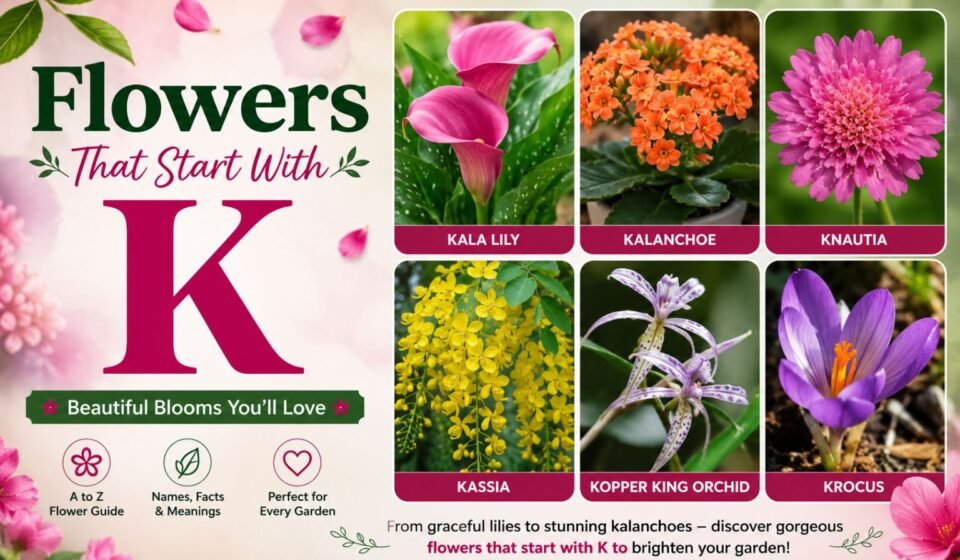
Flowers that start with K are some of the most underrated blooms in gardening. Many gardeners skip this letter because they simply don’t know enough names. This guide fixes that gap. You will find common picks, rare finds, color-based lists, and growing tips. Every section is written to help you plan, plant, and enjoy K flowers with confidence.
Quick Answer: What Are K Flower Names?
K flower names include Kangaroo Paw, Kniphofia, King Protea, Kalmia, and Kerria. These flowers range from tall spiky blooms to soft trailing shrubs. Some grow wild in meadows. Others are prized cut flowers sold in shops. Most K flowers do well in sunny, well drained gardens.
This letter is not as rare as people think. Once you start looking, K flowers show up in perennial beds, tropical gardens, and even indoor pots. They come in nearly every color, shape, and size.
Alphabetical Quick List
Here is a fast reference list of 50 flowers that start with K. Use this as a jumping off point before the deeper sections below.
- Kangaroo Paw
- King Protea
- Kaffir Lily
- Kalmia (Mountain Laurel)
- Kniphofia (Red Hot Poker)
- Knapweed
- Kolkwitzia (Beauty Bush)
- Kerria Japonica
- Kalanchoe
- Korean Chrysanthemum
- Krigia (Dwarf Dandelion)
- Kansas Gayfeather (Liatris)
- Klondike Cosmos
- Kingfisher Daisy
- Kudzu Vine Flower
- Kentucky Coffeetree Flower
- King’s Spear
- Kingcup (Marsh Marigold)
- Knautia Macedonica
- Kalimeris
- Karoo Violet
- Kirengeshoma Palmata
- Kaki Blossom
- Kohleria
- Kalanchoe Pumila
- Kalmiopsis
- Kikyo (Balloon Flower)
- King Alfred Daffodil
- Kwanzan Cherry Blossom
- Kadsura Japonica
- Kalanchoe Tomentosa Flower
- Kaempferia (Peacock Ginger)
- Kalimeris Pinnatifida
- Kentranthus (Red Valerian)
- Kingfisher Sage
- Kokio (Hawaiian Hibiscus)
- Kolomikta Kiwi Flower
- Karonda Flower
- Katsura Flower
- Kansas Sunflower
- Kudzu Bean Flower
- Kniphofia Uvaria
- Kalanchoe Marnieriana
- Knotweed Flower
- Kikuyu Flower
- Kachnar (Bauhinia)
- Kingfisher Gladiolus
- Kalmia Latifolia
- Kolkwitzia Amabilis
- Kalanchoe Thyrsiflora
K Named Flowers: At A Glance
This table gives a snapshot of ten well known K flowers, their type, and native origin. It helps you compare options before reading full details later.
| Flower Name | Plant Type | Native Region |
| Kangaroo Paw | Perennial | Australia |
| King Protea | Shrub | South Africa |
| Kaffir Lily | Bulb | South Africa |
| Kalmia | Shrub | North America |
| Kniphofia | Perennial | South Africa |
| Kolkwitzia | Shrub | China |
| Kerria Japonica | Shrub | Japan, China |
| Korean Chrysanthemum | Perennial | Korea |
| Kikyo | Perennial | East Asia |
| Kalanchoe | Succulent | Madagascar |
Bloom Time And Growing Zones At A Glance
Knowing when a flower blooms helps with planning. This table lists common bloom windows and USDA zones for popular K flowers.
| # | Flower | Typical Bloom Time | USDA Growing Zones |
|---|---|---|---|
| 1 | Kaffir Lily | Late winter–spring | 9–11 |
| 2 | Kalanchoe | Winter–spring | 10–12 |
| 3 | Kalmia | Late spring–early summer | 4–9 |
| 4 | Kangaroo Paw | Spring–summer | 9–11 |
| 5 | Kerria | Spring | 4–9 |
| 6 | King Protea | Spring–fall | 9–11 |
| 7 | Kiss Me Over the Garden Gate | Summer–fall | 4–9 |
| 8 | Knautia | Summer–fall | 4–8 |
| 9 | Knapweed | Summer | 3–8 |
| 10 | Kniphofia | Summer | 5–9 |
| 11 | Korean Bellflower | Summer | 4–8 |
| 12 | Korean Mint | Summer–fall | 5–10 |
| 13 | Kobus Magnolia | Early spring | 5–8 |
| 14 | Kolkwitzia | Late spring | 4–8 |
| 15 | Kosteletzkya | Summer | 4–9 |
| 16 | Kunzea | Spring–summer | 8–11 |
| 17 | Knautia arvensis | Summer–fall | 3–8 |
| 18 | Knautia macedonica | Summer–fall | 5–9 |
| 19 | Kalanchoe luciae | Winter–spring | 9–11 |
| 20 | Kalanchoe tomentosa | Winter–spring | 9–11 |
| 21 | Kalanchoe daigremontiana | Winter–spring | 9–11 |
| 22 | Kalmia angustifolia | Late spring–summer | 2–8 |
| 23 | Kalmia polifolia | Late spring–summer | 2–7 |
| 24 | Kniphofia uvaria | Summer | 5–9 |
| 25 | Kniphofia rooperi | Fall | 5–9 |
| 26 | Kniphofia caulescens | Summer | 6–9 |
| 27 | Kerria japonica | Spring | 4–9 |
| 28 | Kerria japonica ‘Pleniflora’ | Spring | 4–9 |
| 29 | Kolkwitzia amabilis | Late spring | 4–8 |
| 30 | Kobus Magnolia ‘Borealis’ | Early spring | 5–8 |
| 31 | Kangaroo Paw ‘Bush Devil’ | Spring–summer | 9–11 |
| 32 | Kangaroo Paw ‘Bush Ranger’ | Spring–summer | 9–11 |
| 33 | Kangaroo Paw ‘Bush Sunset’ | Spring–summer | 9–11 |
| 34 | King Protea ‘Pink Ice’ | Spring–fall | 9–11 |
| 35 | King Protea ‘White Crown’ | Spring–fall | 9–11 |
| 36 | Korean Mint ‘Blue Fortune’ | Summer–fall | 5–10 |
| 37 | Korean Mint ‘Alabaster’ | Summer–fall | 5–10 |
| 38 | Kosteletzkya virginica | Summer–fall | 5–9 |
| 39 | Kosteletzkya pentacarpos | Summer–fall | 5–9 |
| 40 | Kunzea ambigua | Spring–summer | 8–11 |
| 41 | Kunzea ericoides | Spring–summer | 8–10 |
| 42 | Knapweed ‘Black Gem’ | Summer | 3–8 |
| 43 | Knapweed ‘Amethyst Dream’ | Summer | 3–8 |
| 44 | Knautia ‘Thunder and Lightning’ | Summer–fall | 4–9 |
| 45 | Knautia ‘Mars Midget’ | Summer–fall | 4–9 |
| 46 | Korean Bellflower ‘Elizabeth’ | Summer | 4–8 |
| 47 | Korean Bellflower ‘Beautiful Trust’ | Summer | 4–8 |
| 48 | Kaffir Lily ‘Orange’ | Late winter–spring | 9–11 |
| 49 | Kaffir Lily ‘Yellow’ | Late winter–spring | 9–11 |
| 50 | Kalanchoe ‘Calandiva’ | Winter–spring | 10–12 |
| 51 | Kalanchoe ‘Flapjack’ | Winter–spring | 9–11 |
| 52 | Kalmia latifolia ‘Minuet’ | Late spring | 4–9 |
| 53 | Kalmia latifolia ‘Olympic Wedding’ | Late spring | 4–9 |
| 54 | Kniphofia ‘Alcazar’ | Summer | 5–9 |
| 55 | Kniphofia ‘Royal Standard’ | Summer | 5–9 |
Bloom time shifts slightly by climate. Warmer zones often see earlier flowering. Cooler zones push bloom time back by a few weeks.
Plants Vs Flowers That Start With K
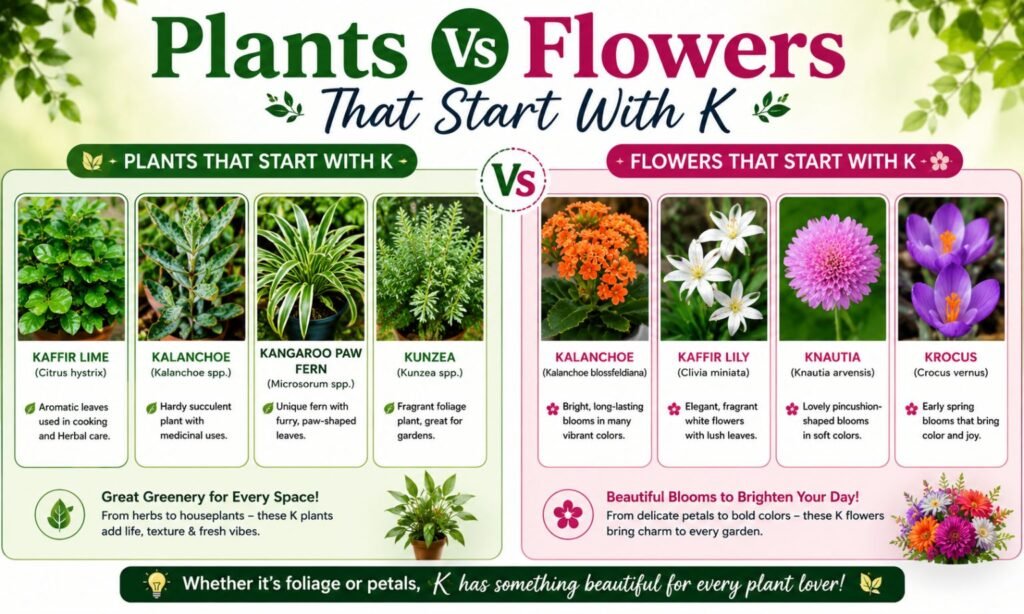
Not every K name refers to a flower. Some are trees, shrubs, or vines that simply produce flowers as part of their growth. Understanding the difference helps avoid confusion when shopping at a nursery.
Kalmia and Kolkwitzia are shrubs that flower seasonally. Kentucky Coffeetree is a large tree with small blooms. Kudzu is a vine known more for its aggressive growth than its flowers. True flowering plants, like Kniphofia and Kaffir Lily, are grown mainly for their blooms.
This distinction matters for garden planning. A shrub needs space and years to mature. A true flower can be planted and enjoyed within one season.
Types of Flowers That Start With K
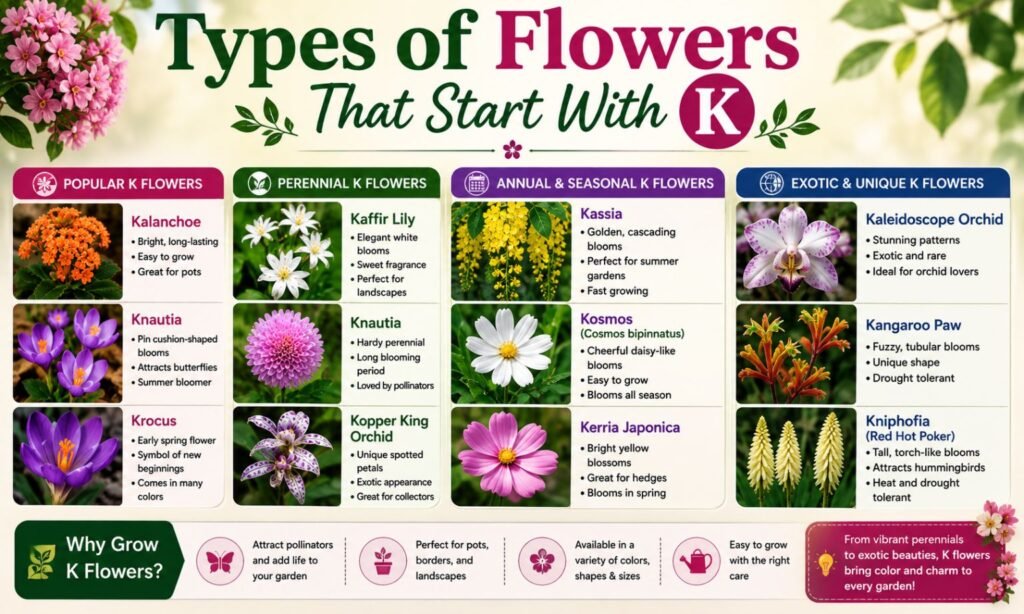
K flowers fall into several useful categories. Below are three important groups every gardener should know.
Perennials That Start With K
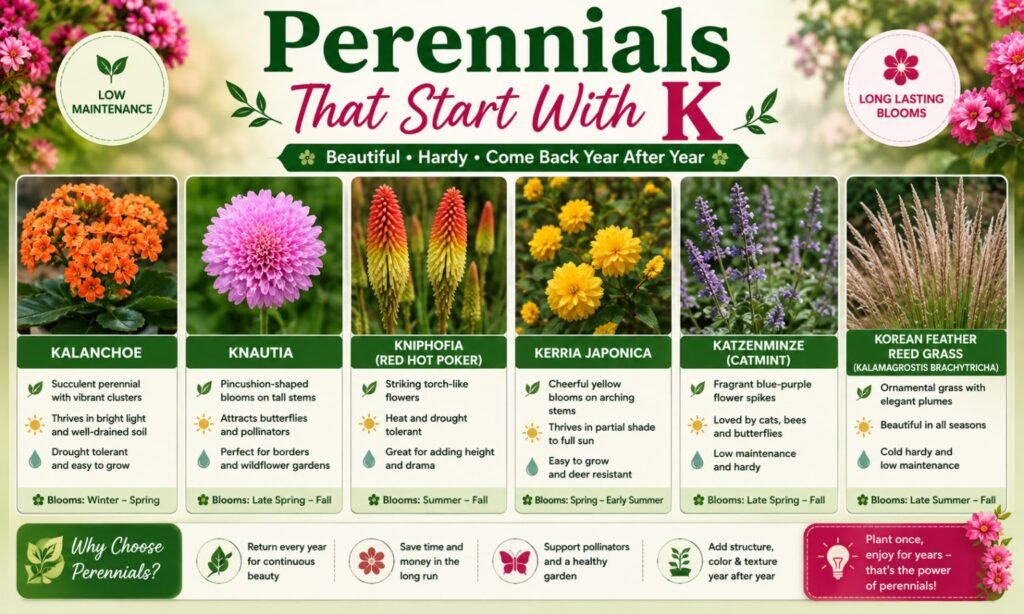
Perennials come back year after year with little replanting effort. They are a smart choice for low maintenance gardens.
- Kniphofia
- Kaffir Lily
- Korean Chrysanthemum
- Knautia Macedonica
- Kirengeshoma Palmata
These plants build stronger root systems each year. Many perennials on this list also attract pollinators, making them a functional and beautiful choice.
Annual Flowers That Start With K
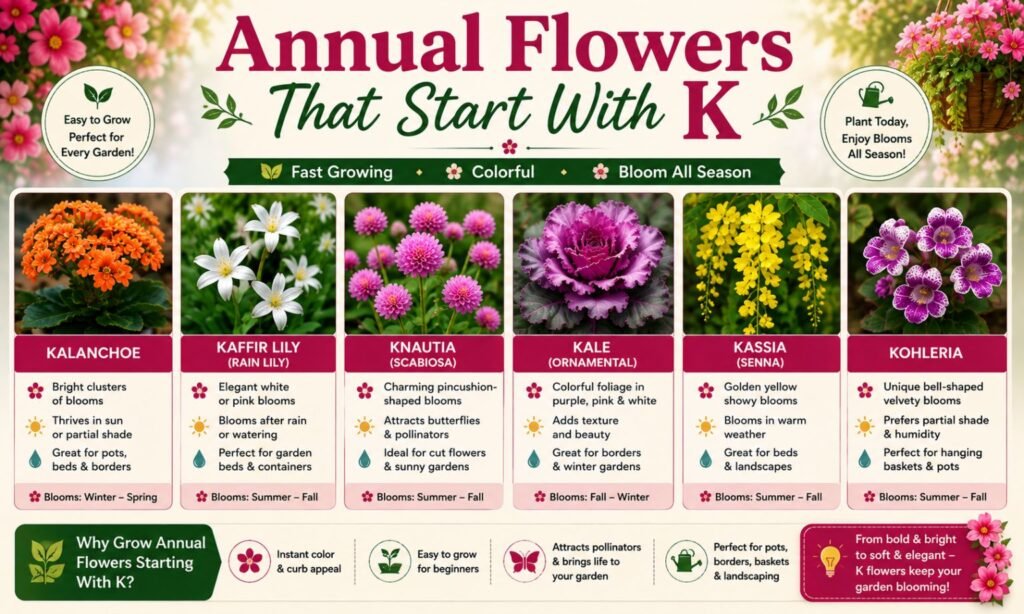
Annual flowers complete their life cycle in one growing season. They need replanting each year but often bloom heavily.
- Klondike Cosmos
- Kingfisher Daisy
- Krigia (Dwarf Dandelion)
Annuals are great for gardeners who like to change color schemes often. They also fill gaps quickly in a young garden bed.
Purple Flowers That Start With K
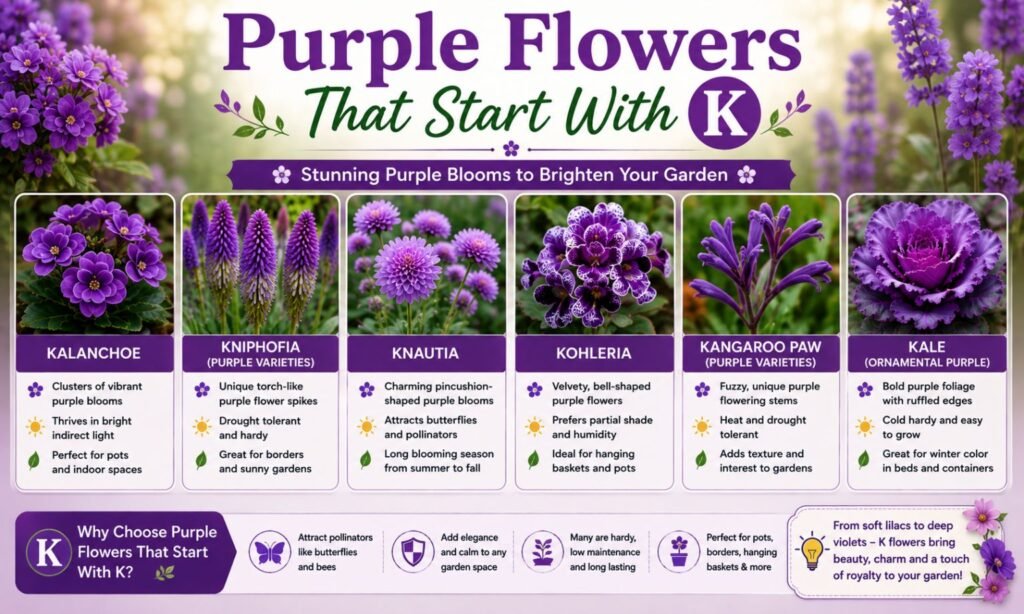
Purple is a common shade among K flowers. It pairs well with green foliage and adds a cool tone to any bed.
- Knautia Macedonica
- Karoo Violet
- Kalimeris
Purple K flowers work well near white or silver foliage plants. This combination creates strong visual contrast in garden borders.
Explore More Flowers Guides
85 Amazing Flowers That Start With J
55 Amazing Flowers That Start With I
K Flower Names By Color
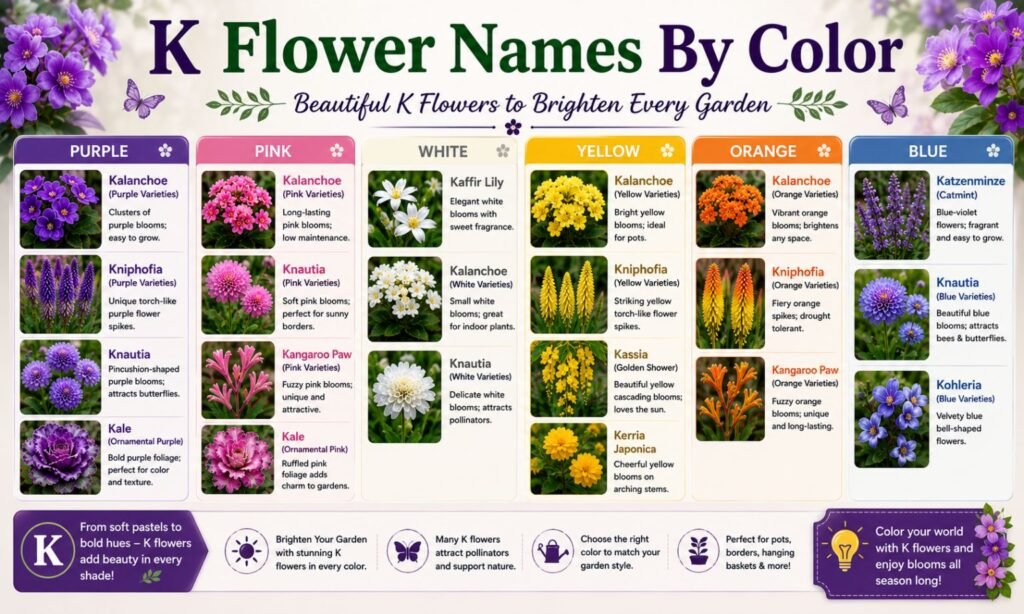
Color is often the first thing gardeners consider. Below is a breakdown of K flowers grouped by their most common shades.
| Color | Flower Examples |
| Red | Kniphofia, Kaki Blossom |
| Orange | King Protea, Kangaroo Paw |
| Yellow | Kirengeshoma, Kingcup |
| Purple | Knautia Macedonica, Karoo Violet |
| White | Kerria (white varieties), Kadsura |
| Pink | Kolkwitzia, Kwanzan Cherry Blossom |
Color choice affects more than looks. Bright colors like red and orange draw more pollinator attention. Soft tones like white and pink work better for calm, formal garden designs.
Are There Indoor Flowers That Start With K?
Yes, several K flowers grow well indoors. Kalanchoe is the most popular choice for pots. Kohleria also does well in bright, indirect light.
Indoor K flowers need less watering than outdoor types. Most prefer a spot near a window with filtered sunlight rather than direct harsh rays.
Which K Flowers Are Good For Beginners?
Kniphofia and Kalanchoe are excellent beginner choices. Both are forgiving of missed watering and adapt to different soil types.
New gardeners should avoid Kalmia at first, since it prefers specific acidic soil. Starting with easier plants builds confidence before trying trickier species.
Best K Flowers By Use
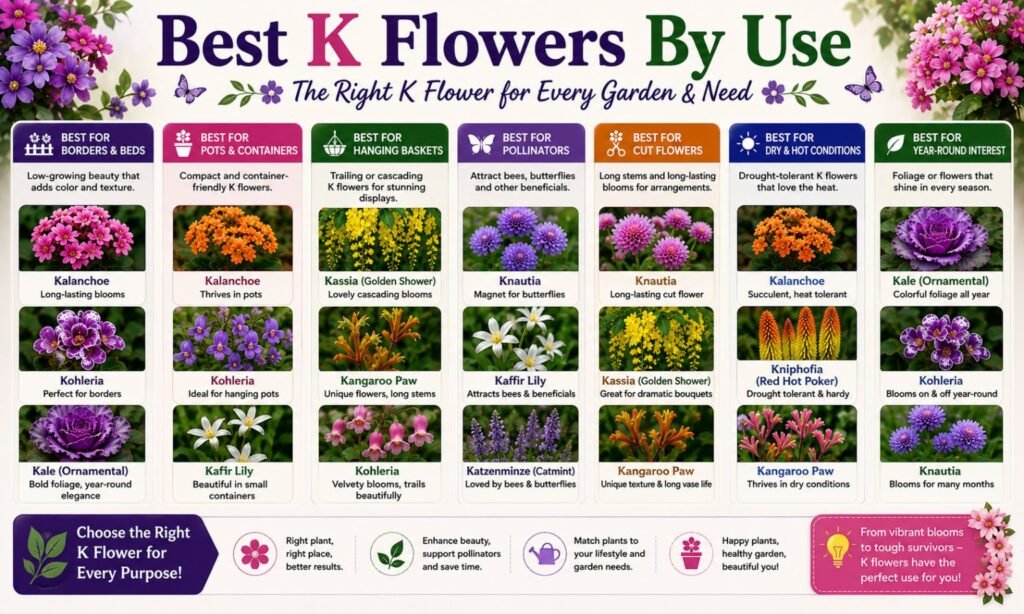
Different flowers suit different purposes. Some work best as cut flowers, others shine in garden beds, and some are chosen mainly for scent.
| Use Case | Best K Flower |
| Cut Flowers | Kniphofia, King Protea |
| Ground Cover | Kerria Japonica |
| Hedging | Kolkwitzia |
| Rock Gardens | Kalmiopsis |
| Container Gardens | Kalanchoe |
Fragrant And Pollinator Friendly K Flowers
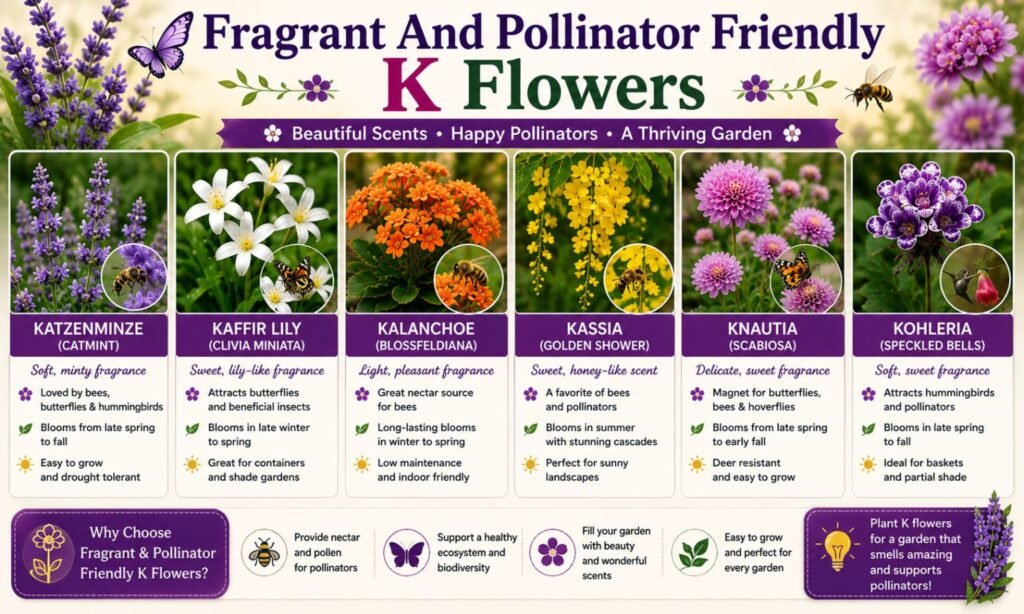
Some K flowers are grown specifically for scent or their ability to attract bees and butterflies.
- Kolkwitzia (light honey scent)
- Kerria Japonica (mild fragrance)
- Kniphofia (attracts hummingbirds and bees)
Fragrant flowers work well near patios or windows. Pollinator friendly types are best planted in open beds where bees can access them easily.
Common Flowers That Start With K
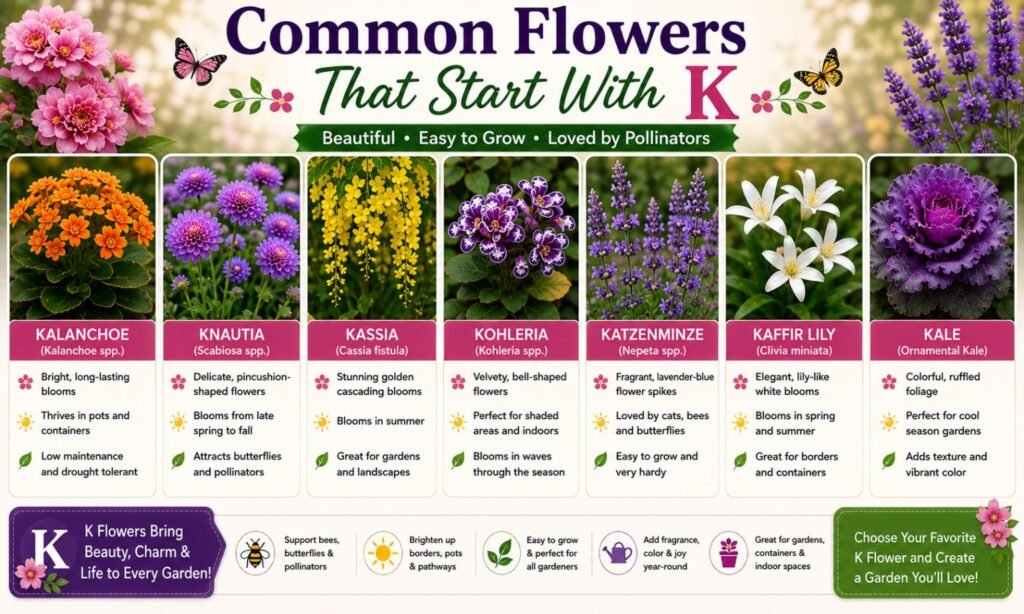
If you’re looking for K flowers that are easy to recognize and useful in everyday gardens, several stand out for very different reasons. Some are compact houseplants, while others become shrubs, trees, or striking landscape flowers.
| Flower | What Makes It Unique |
|---|---|
| Kaffir Lily | Its strap-like leaves stay attractive even when the plant is not blooming, making it useful for shady spaces. |
| Kalanchoe | A popular flowering succulent that stores water in its thick leaves and can bloom for an extended period indoors. |
| Kalmia | Its unusual flowers resemble tiny folded cups and often have distinctive markings inside each bloom. |
| Kangaroo Paw | The tubular, fuzzy flowers resemble a kangaroo’s paw and are especially attractive to nectar-feeding birds. |
| Kerria | Its bright yellow flowers can bring strong spring color to partially shaded garden areas. |
| King Protea | One of the most dramatic K flowers, with a huge flower head surrounded by colorful, pointed bracts. |
| Kiss Me Over the Garden Gate | Its tall stems and dangling clusters of pink flowers create a soft, cascading effect in informal gardens. |
| Knautia | Its small pincushion-like blooms sit on long, slender stems, giving borders a light, airy appearance. |
| Knapweed | Its thistle-like flower heads make it easy to recognize, although some species can spread aggressively. |
| Kniphofia | Commonly called red hot poker, its upright flower spikes often transition from red or orange at the top to yellow below. |
| Korean Bellflower | Its large, bell-shaped flowers hang gracefully and can add a distinctive look to cottage-style borders. |
| Korean Mint | Despite its common name, it is best known as a pollinator-friendly flowering perennial with aromatic foliage. |
| Kobus Magnolia | This flowering tree produces fragrant white blossoms before or around the time its spring foliage develops. |
| Kolkwitzia | Often called beauty bush, it produces arching branches covered with clusters of pink, bell-shaped flowers. |
| Kosteletzkya | Its hibiscus-like flowers make it especially interesting for damp gardens, rain gardens, and moisture-retentive locations. |
| Kunzea | Its small flowers can appear in fluffy clusters and are valuable for attracting pollinators in suitable climates. |
🌸 What Makes K Flowers Interesting?
K flowers are surprisingly diverse. The group includes succulents, shrubs, trees, perennials, annuals, and ornamental grasses-like forms, so there isn’t one typical “K flower” appearance.
- Best indoor choice: Kalanchoe
- Best dramatic flower: King Protea
- Best unusual shape: Kangaroo Paw
- Best spring shrub: Kerria
- Best bold border flower: Kniphofia
- Best flowering tree: Kobus Magnolia
- Best pollinator choices: Knautia and Korean Mint
- Best for damp areas: Kosteletzkya
- Best cottage-garden options: Korean Bellflower and Kiss Me Over the Garden Gate
Interesting fact: The letter K gives gardeners some particularly memorable common names, including Kangaroo Paw, King Protea, Kiss Me Over the Garden Gate, and Red Hot Poker (Kniphofia)—names that often make these plants easier to remember than their botanical names.
What Are Rare Flowers That Start With K?
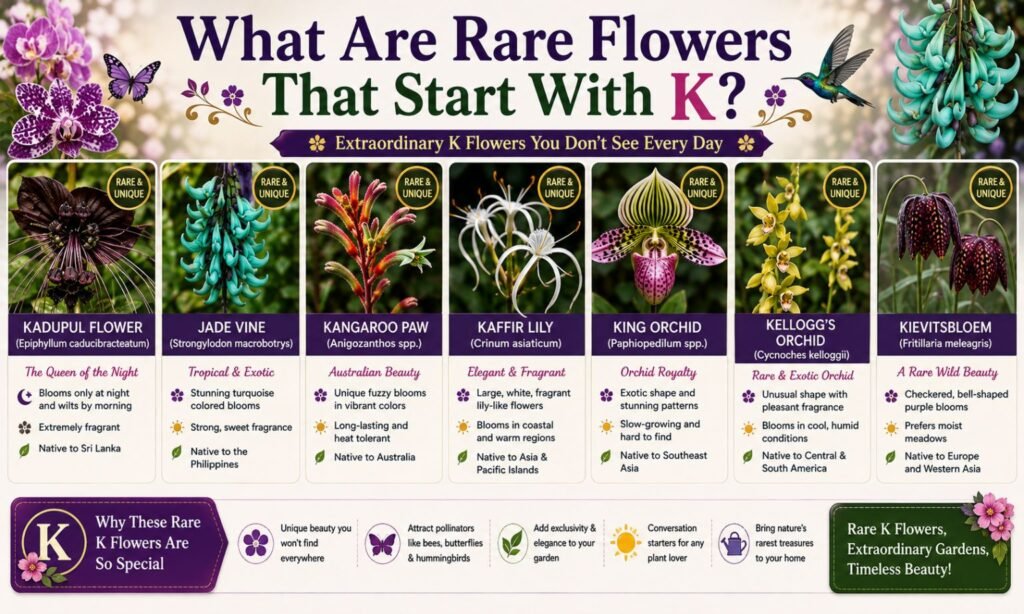
Rare K flowers are harder to find in standard garden centers. They often require specialty nurseries or seed exchanges.
- Kirengeshoma Palmata
- Kadsura Japonica
- Karoo Violet
- Kalmiopsis
These rare varieties often have narrower growing conditions. Kalmiopsis, for example, needs specific rocky, well drained soil found in limited native regions. Gardeners who want rare K flowers should expect a longer search and possibly higher cost.
Before Planting K Flowers: Safety, Invasive, And Climate Notes
Not every K flower is safe or simple to grow. A few carry risks worth knowing before planting.
Kalmia contains toxins that are harmful if ingested by pets or livestock. Kudzu is considered invasive in many parts of the United States and can overtake native plants quickly. Always check your local climate zone before buying, since some K flowers, like King Protea, only thrive in warm, frost free areas.
Checking these details early saves time and prevents garden problems later.
Growing Snapshot
This section summarizes the core growing needs of popular K flowers in one place.
| Flower | Sun Need | Water Need |
| Kniphofia | Full Sun | Low to Medium |
| Kalmia | Partial Shade | Medium |
| Kerria Japonica | Partial Shade | Medium |
| Kalanchoe | Bright Light | Low |
| King Protea | Full Sun | Low |
Sun, Soil, Water, And Bloom Season Patterns
Most K flowers prefer well drained soil. Full sun types, like Kniphofia and King Protea, need at least six hours of light daily. Shade tolerant types, like Kalmia and Kerria, do better with morning sun and afternoon shade.
Watering needs vary by species. Succulent types like Kalanchoe need far less water than perennial types like Korean Chrysanthemum. Bloom season also shifts with sun exposure, since more light often speeds up flowering.
Common Growing Mistakes
Many beginners overwater succulent K flowers like Kalanchoe, leading to root rot. Others plant Kalmia in soil that is too alkaline, which stunts growth.
Spacing is another common issue. Shrubs like Kolkwitzia need more room than gardeners expect, and crowding them limits airflow and increases disease risk.
Best Garden Uses
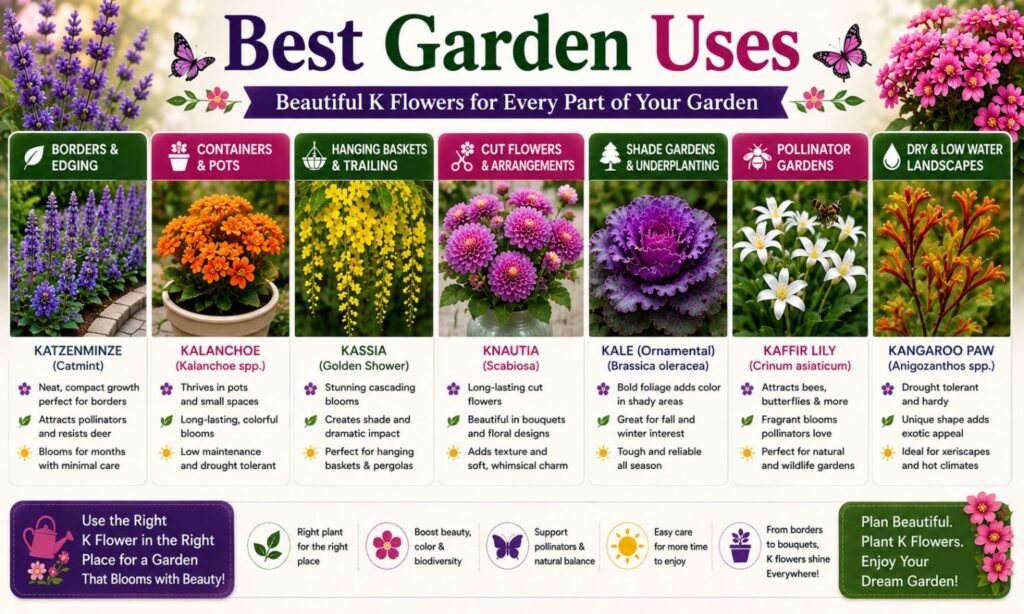
K flowers serve many roles in a garden, from filling borders to creating focal points in containers.
Beds, Borders, Containers, And Bouquets
- Beds: Kniphofia, Korean Chrysanthemum
- Borders: Knautia Macedonica, Kalimeris
- Containers: Kalanchoe, Kohleria
- Bouquets: King Protea, Kniphofia
Each use case benefits from matching plant height and bloom color to its role. Tall flowers like Kniphofia work best at the back of a bed, while low growers like Kalanchoe suit the front edge or pots.
Garden Style Matches
Cottage gardens pair well with Kerria Japonica and Kolkwitzia for their soft, informal look. Modern minimalist gardens suit King Protea and Kniphofia, since their bold shapes stand out against clean lines. Rock gardens favor Kalmiopsis for its compact, hardy nature.
Conclusion
Flowers that start with K offer far more variety than most people expect. From bold King Protea blooms to gentle Kerria shrubs, this letter covers nearly every garden style and skill level. Whether you want low maintenance perennials, rare specialty plants, or simple indoor pots, there is a K flower suited to your space.
Take time to match each flower to your climate, sun exposure, and soil type. Doing so will lead to healthier plants and longer lasting blooms throughout the growing season.
FAQ’s
What is the most popular flower that starts with K?
Kniphofia, also called Red Hot Poker, is one of the most popular K flowers. It is easy to grow and adds bold color to gardens.
Are there any purple flowers that start with K?
Yes, Knautia Macedonica and Karoo Violet are both purple flowering plants. They work well in mixed perennial borders.
What K flower is best for indoor pots?
Kalanchoe is the top choice for indoor growing. It needs bright light and very little water to thrive.
Is Kalmia safe to plant near pets?
No, Kalmia contains toxins that can harm pets if eaten. It should be planted away from areas pets can access.
What is a rare flower that starts with K?
Kirengeshoma Palmata is considered rare and is not commonly found in standard garden centers.
Do K flowers attract bees and butterflies?
Yes, Kniphofia and Kolkwitzia are both known to attract bees, butterflies, and hummingbirds during bloom season.
Can King Protea grow in cold climates?
No, King Protea needs a warm, frost free climate. It struggles or dies in cold winter regions below its hardiness zone.